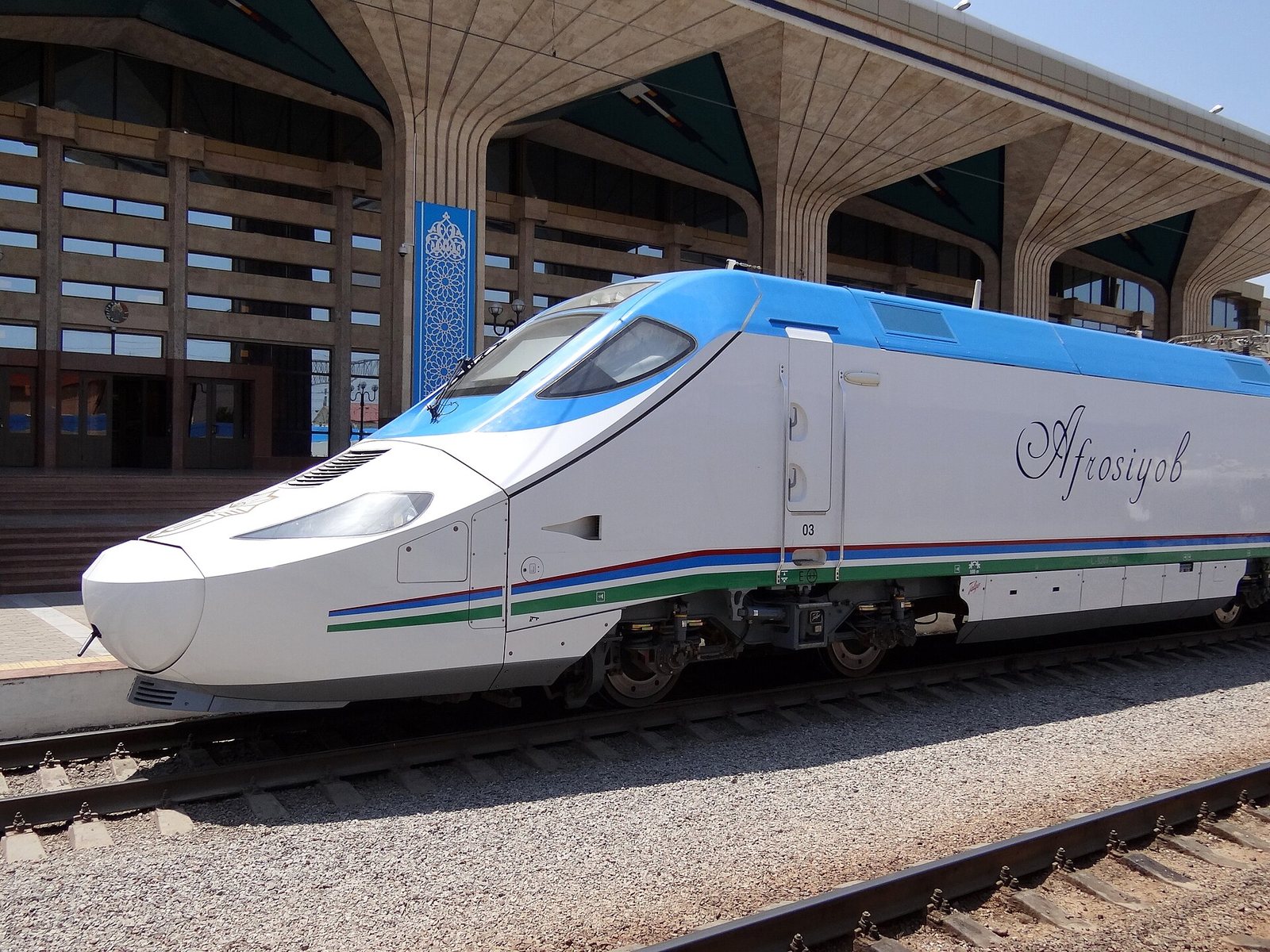
Getting around Uzbekistan is far easier than its size and remoteness suggest, because the country has invested in one thing exceptionally well: high-speed rail. The Afrosiyob and its newer sibling do the heavy lifting between the Silk Road cities, fast and comfortably, and within cities a single taxi app removes all the friction of haggling. The only real skill is booking trains early enough to get a seat. This guide covers every mode — trains, taxis, flights, shared taxis, the metro — and how to combine them.
What are the trains like?
The railway is the single best thing about travelling here. The Afrosiyob turns long desert distances into easy, scenic rides — Economy is perfectly comfortable for these 2–4 hour journeys, though Business and VIP add space and better snacks. Tea and a small snack come even in Economy. If the Afrosiyob is sold out, the Sharq covers the same Tashkent–Samarkand–Bukhara corridor at roughly half the price and only slightly slower, in closed compartments — a very decent backup. Overnight sleeper trains handle the longest routes. Tip: travelling west, sit on the left for mountain views. Trains underpin every itinerary in our first-trip guide.
Other countries make you choose between fast and scenic. Uzbekistan's railway quietly gives you both — if you book in time.
Is there now a fast train to Khiva?
This is the biggest recent shift in Uzbek travel. Reaching Khiva used to mean a ~14-hour overnight train or a long desert drive; the new Jaloliddin Manguberdi high-speed service makes it a ~7.5-hour day trip from Tashkent, transforming how you can sequence a route. Because it's new, popular and runs only a few days a week, it books out quickly — and as a recent launch, schedules are still settling, so confirm current days and times before you build a plan around it. Many travelers now take the sleeper one way for the experience and the fast train back. See how Khiva fits in our 10-day route.
How do you book train tickets?
This is the one piece of planning that actually matters. The affordable economy seats on the Afrosiyob and the new Khiva train sell out first — sometimes within days — leaving only costly Business/VIP or nothing. So treat trains as your first booking, not an afterthought. Use the official site (railway.uz) or the UzRailways app; a known quirk is that availability sometimes differs between the two, so check both. Avoid third-party resellers' mark-ups where you can, though hotels will book for a small fee if the official site frustrates you. Bring the exact passport you booked with, and arrive ~30 minutes early for the passport and luggage check; boarding closes about 5 minutes before departure.
How do taxis work in the cities?
Within cities, ride-hailing solves the classic traveler headache. Yandex Go (download before you arrive) gives a set fare and a tracked car, removing the awkward fare negotiation that street taxis demand — and it's typically cheaper too. MyTaxi, a homegrown app, works well in Tashkent but has thinner driver coverage elsewhere. Street taxis are everywhere and cheap, but require bargaining in som and tend to overcharge obvious foreigners. One limit to remember: ride-hailing apps are within-city only — you can't book Tashkent to Samarkand on Yandex. And in Khiva, apps are nearly useless, since the walled Itchan Kala is pedestrian-only; just walk, or arrange a local driver.
What about shared taxis and buses?
For everything off the main rail corridor, shared taxis are the local solution. You pay per seat (not the whole car), they depart when full from a known stand, and they reach places trains don't — across mountain passes to the Fergana Valley, through villages on the Samarkand–Shahrisabz road, to the edge of the desert toward Nukus. The trade-off is comfort (cramped) and timing (you wait for the car to fill). They're cheap and authentic. For remote sights — the desert forts, the Aral Sea — a hired car with a driver is usually the practical choice, as covered in our off-the-beaten-path guide. Bring cash for all of these.
When should you fly?
Flights make sense only for distance. The rail-served core cities are best by train — faster door-to-door once you count airport time, and far more scenic. But for the remote west, a domestic flight is a gift: returning from Nukus or Urgench to Tashkent by air turns a punishing overland day into a short hop. Uzbekistan Airways covers the regional airports, and flying open-jaw — in to one city, out of another — can save both time and money, as noted in our budget guide. Children under 5 generally fly free, with discounts for ages 5–10.
What about the Tashkent metro and airport transfers?
In the capital, the metro is both transport and attraction — ride it at least once for the palatial stations alone, and use it to reach Chorsu Bazaar, the opera and the central squares for a tiny fare (buy a token or use a card at the entrance). At Tashkent airport, skip the marked-up hotel transfer: the official taxi desk in the arrivals hall sets a fair price by distance and takes card or cash, or you can use Yandex Go. Budget buses run into the city too. The same airport-desk logic applies in Samarkand and Bukhara — official options beat the touts who meet arriving trains and flights.
Frequently asked questions about getting around Uzbekistan
What's the best way to travel between the Silk Road cities?
The Afrosiyob high-speed train, without question — Tashkent–Samarkand in about 2 hours, Samarkand–Bukhara in 1.5, comfortable and punctual. Book early on the official site as it sells out. For Khiva, the new 2026 high-speed line or the overnight sleeper. Trains beat driving on every count: speed, comfort and safety.
How far in advance should I book trains?
As soon as your dates open — the window is roughly 45 days ahead. The cheap economy seats on the Afrosiyob and the new Khiva train sell out fast, especially in spring and autumn and around national holidays, leaving only pricier classes. Book trains before hotels; they're the real bottleneck in Uzbekistan travel.
Does Uber work in Uzbekistan?
No — Uber left years ago. Download Yandex Go instead, the standard ride-hailing app, which works in Tashkent, Samarkand, Bukhara and other cities with fixed prices shown upfront. MyTaxi is a local alternative. Both are within-city only; for intercity travel use the train or a shared/private taxi, not an app.
Is there finally a fast train to Khiva?
Yes. The new Jaloliddin Manguberdi high-speed line opened in 2026, cutting Tashkent–Khiva from about 14 hours to roughly 7.5. It runs only a few days a week and books out fast, and as a recent launch its schedule is still settling — confirm current days on the official railway site. The overnight sleeper remains a cheaper, atmospheric alternative.
Should I rent a car and drive myself?
Generally no. Driving standards are well below Western norms, some intercity roads are poorly maintained, and trains are faster and far less stressful between the main cities. For remote sights without rail or shared-taxi access, hire a car with a local driver rather than self-driving — they know the roads and wait while you explore. Save your energy for the sightseeing.
Want to see Uzbekistan the way the people who live here see it?
Become a Kvazar Explorer →