Culture of Uzbekistan
Architecture, ornament and visual language in translated Kvazar stories.
 Culture
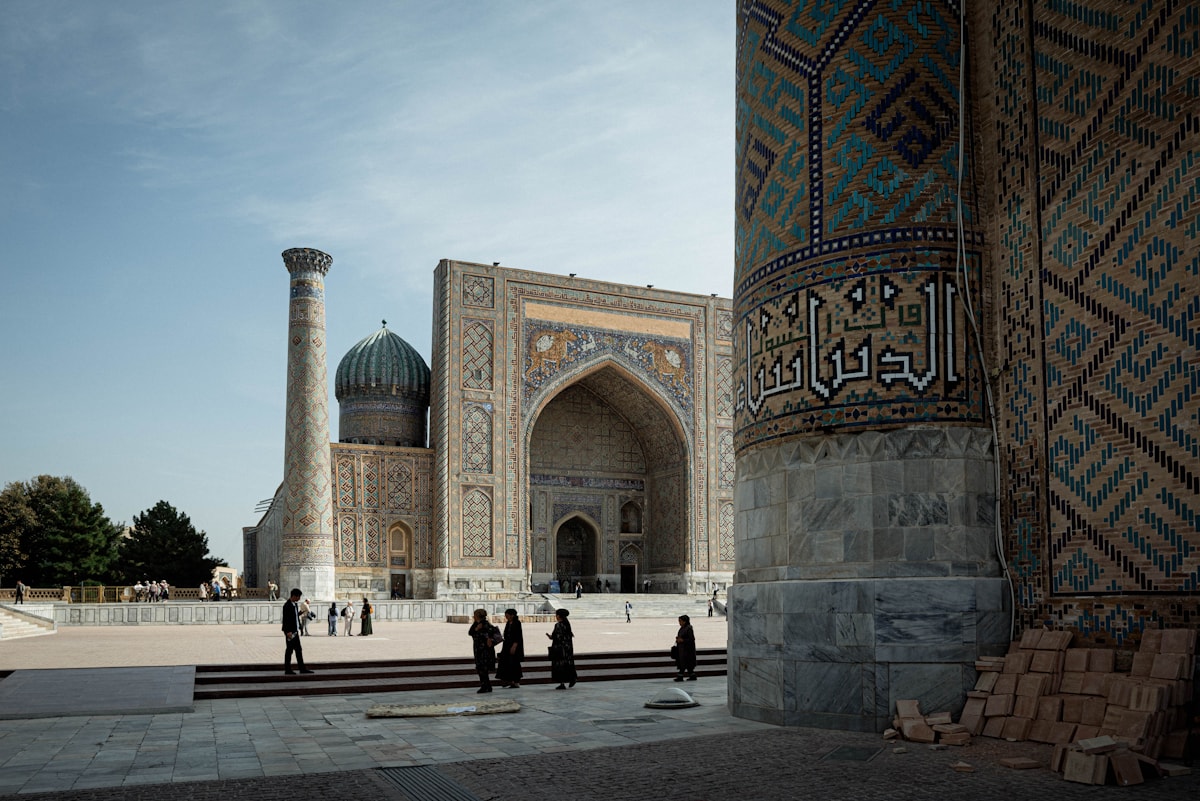
Why Are the Domes of Samarkand Blue?
The color is unmistakable: deep turquoise against a bleached sky. But it isn't just beauty — behind it lie the chemistry of distant mines, the symbolism of water in a desert, and the imperial taste of an entire era.
 Culture
Girih: The Geometry in Which the Middle Ages Outran Mathematics
What looks like merely a beautiful pattern on the walls of Samarkand and Bukhara is actually a system. The stars, polygons and interlaced lines are built by exact rules — and behind them stands the idea of infinity.
 Traditions
Tea Etiquette: Three Pourings and the Bowl of Respect
Before pouring a guest tea, the host pours it three times from the bowl back into the pot. And the most honored guest is given the least of all. Behind these gestures lies a whole philosophy:
 Traditions
Ramadan and Iftar: A Month of Fasting and Shared Tables
A whole month from dawn to sunset — no food, no water. And at sundown comes iftar: the breaking of the fast, begun with a date and a sip of water, and shared tables laid for the whole mahalla. Ramadan in?
 Culture
Uzbek Carpets: Julkhirs, Gilam and a Lost Secret
The Spanish king
 Traditions
Navruz: The New Year Greeted in Spring
Navruz — the ancient festival of the spring equinox and the solar New Year, marked on March 21. Why women stir sumalak from sprouted wheat all night and why on this day people forgive grievances. A Kvazar?
 Traditions
The Mahalla: The Neighborhood Community as a Way of Life
In an Uzbek neighborhood a neighbor is not just the person behind the wall. Weddings and funerals are held together, a house is built by the whole community, and help comes to anyone in trouble. This is the?
 Traditions
The Toy: An Uzbek Wedding for Hundreds of Guests
An Uzbek wedding isn
 Traditions
Hashar: When the Whole Quarter Works as One
A house needs building, a street needs tidying, the mahalla needs readying for a holiday — and by morning the neighbors come out as one, for no pay. In a single day a friendly crowd does what would take a?
 Traditions
Beshik-Toyi: The Festival of the Cradle
When a newborn is a few days old, the mother
 Traditions
Sunnat-Toyi: A Boy's Coming-of-Age Festival
In the life of an Uzbek boy there
 Traditions
Amulets Against the Evil Eye: Tumor, Kuzmunchok and the Blue Eye
A blue eye-bead on a baby
 Traditions
The Tyubeteika: The Cap by Which a Person Is Read
A black cap with a white pattern seems a simple souvenir — but someone in the know will read from it which region its wearer comes from. The shape, color and ornament of the tyubeteika make up a code: four?
 Traditions
Hospitality and the Dastarkhan: Why the Guest Ranks Above Courage
"Hospitality is higher than courage," says an old proverb. To refuse a guest, not to seat them at the table, not to treat them, meant to bring shame not only on yourself but on your whole kin. Behind it lies?