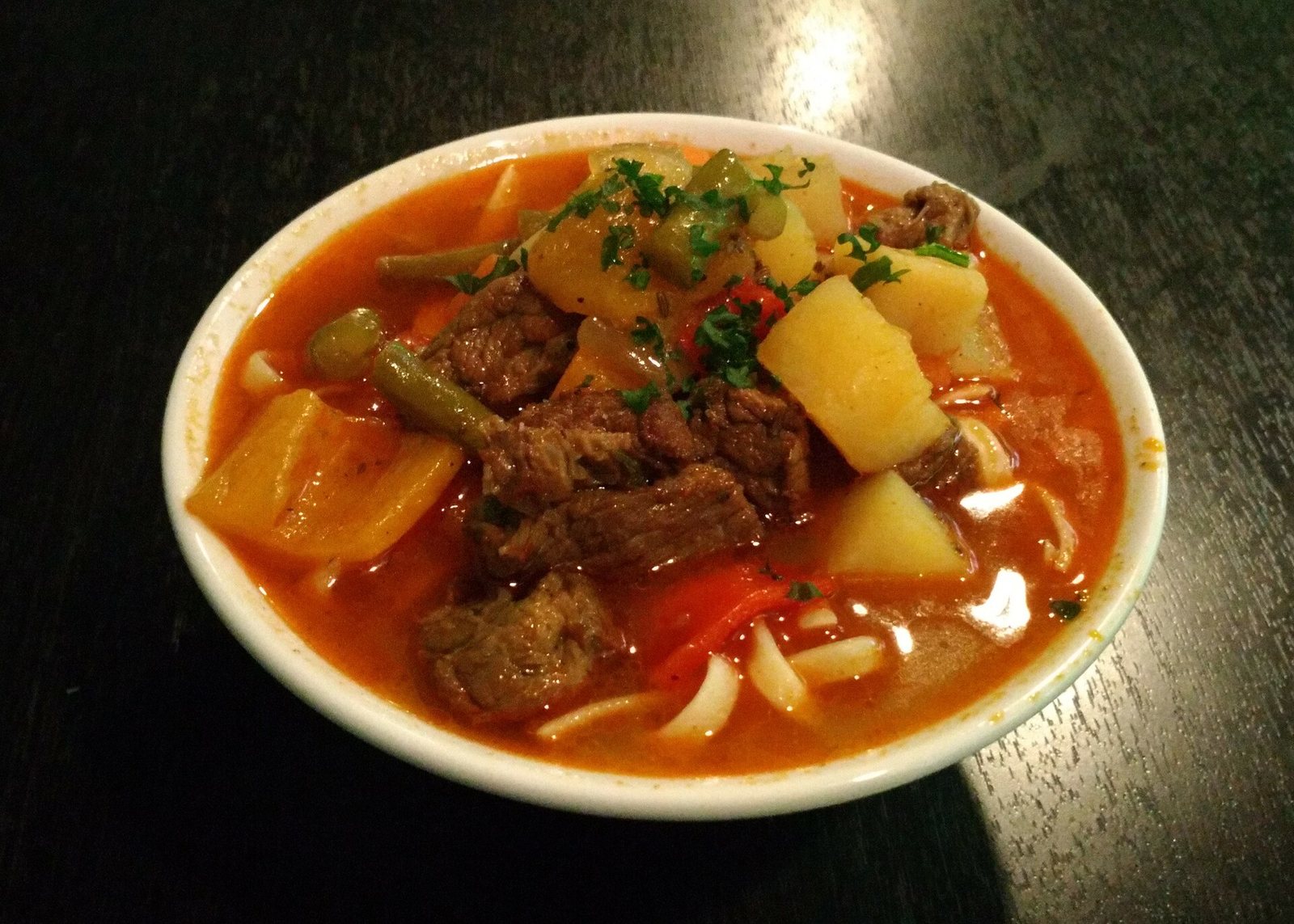
Lagman is one of those dishes that show how Uzbek cuisine grew up at a crossroads of cultures. It was brought to Central Asia by the Uyghurs and Dungans, and the name means literally, from Chinese, "pulled noodles." Today lagman is eaten all over Uzbekistan, and you can argue endlessly about the "right" version — because there are several right ones. Let's work out what this dish is, how pulled noodles differ from cut ones, and why lagman never decided whether it's soup or a main.
What is Uzbek lagman?
The name "lagman" goes back to the Chinese "lamian" — "pulled noodles," and that points at once to the dish's homeland and its main secret. In different regions of Uzbekistan lagman is made its own way: the set of vegetables, the heat and the thickness vary. The vegetable part is usually rich — onion, carrot, bell pepper, tomatoes, sometimes radish, eggplant, potato; the spices are cumin, garlic, pepper and plenty of herbs (especially cilantro).
Plov is measured by its rice, lagman by its noodles. In both, the flavor is decided not by complexity but by the hands of whoever makes it.
How do pulled noodles differ from cut ones?
Pulling noodles is a skill of its own, and the sight is mesmerizing: the dough is twirled like a skipping rope or stretched between the palms, the strands doubled over again and again until a single cord becomes a whole skein of noodles. The dough is taken fairly stiff, like for dumplings; some add an egg, some don't (without egg the noodles are more tender). The cords are brushed with oil and the dough is given a "rest" — otherwise it tears when stretched.
Is lagman a soup or a main dish?
This "duality" isn't a flaw but a property of the dish: the same lagman is easily turned from a soup into a main just by adjusting the broth. So when ordering lagman in different places, don't be surprised that the bowl is a slightly different dish each time. If you like rich soups, look also at shurpa — another signature Uzbek lamb soup.
How is lagman assembled?
We don't give exact weights — the proportions and the set of vegetables vary widely. What matters is the logic of assembly: the noodles and the vaja are made separately and joined in the bowl.
Lagman: the order of steps
- Mix the dough. Flour, water, salt (optionally an egg); knead until stiff and smooth, cover and let rest 30–40 minutes.
- Pull the noodles. Roll cords, brush with oil and stretch, doubling over, until you get thin long strands (this is chuzma; for kesma — roll out and cut).
- Boil the noodles. In salted boiling water until done, drain, optionally rinse and drizzle with oil.
- Fry the meat. Fry the cut meat in a cauldron with onion until golden.
- Make the vaja. Add carrot, pepper, tomatoes (and other vegetables), tomato paste, spices (cumin, garlic, pepper), pour in water and stew until done — this is the sauce.
- Assemble in the bowl. Lay out the noodles, pour over the vaja, sprinkle generously with fresh herbs (cilantro, green onion). More broth — soup; less — a main.
Frequently asked questions about lagman
Is lagman a soup or a main dish?
It can be either — it all comes down to the amount of broth. Lots of liquid makes a soup; little makes noodles with a thick sauce, like a stew. In Uzbekistan lagman is more often eaten as a thick soup.
What is chuzma lagman?
It's lagman with pulled noodles: they aren't cut but stretched by hand from the dough into long thin strands (from the Uzbek "chuzmoq" — to pull). The opposite is kesma lagman, where the noodles are cut with a knife.
What is vaja?
Vaja is the sauce of lagman: stewed meat with vegetables and spices, used to top the boiled noodles. The noodles and the vaja are made separately and joined in the bowl when serving.
What meat is lagman made from?
Most often lamb or beef. Pork isn't put in traditional Uzbek lagman. The meat is fried with onion and then stewed with vegetables to make the aromatic vaja.
Can you make lagman without pulled noodles?
Yes — that will be kesma lagman with cut noodles, and it's also considered Uzbek. Pulled noodles (chuzma) are more spectacular and take skill, but they affect the taste of the finished dish less than the meat, vegetables and spices.
Want to understand Uzbek food not as "exotica" but as a living culture with its own rules?
Become a Kvazar Explorer →