Overview
Cities
Eleven cities with different characters - from Samarkand's blue domes and Margilan silk to Nukus avant-garde and the Buddhist past of Termez.
Eleven cities with different characters - from Samarkand's blue domes and Margilan silk to Nukus avant-garde and the Buddhist past of Termez.
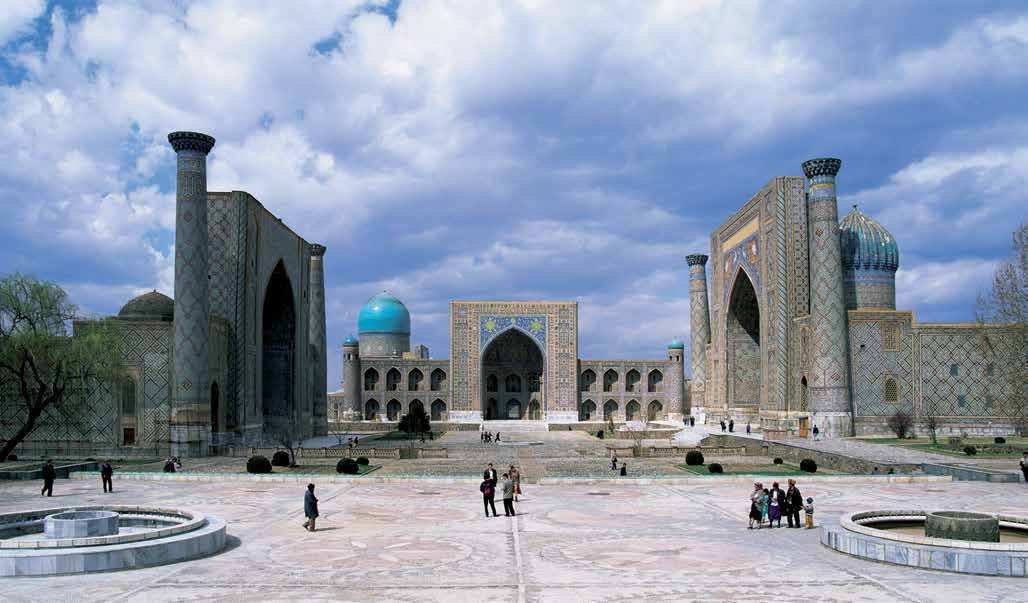
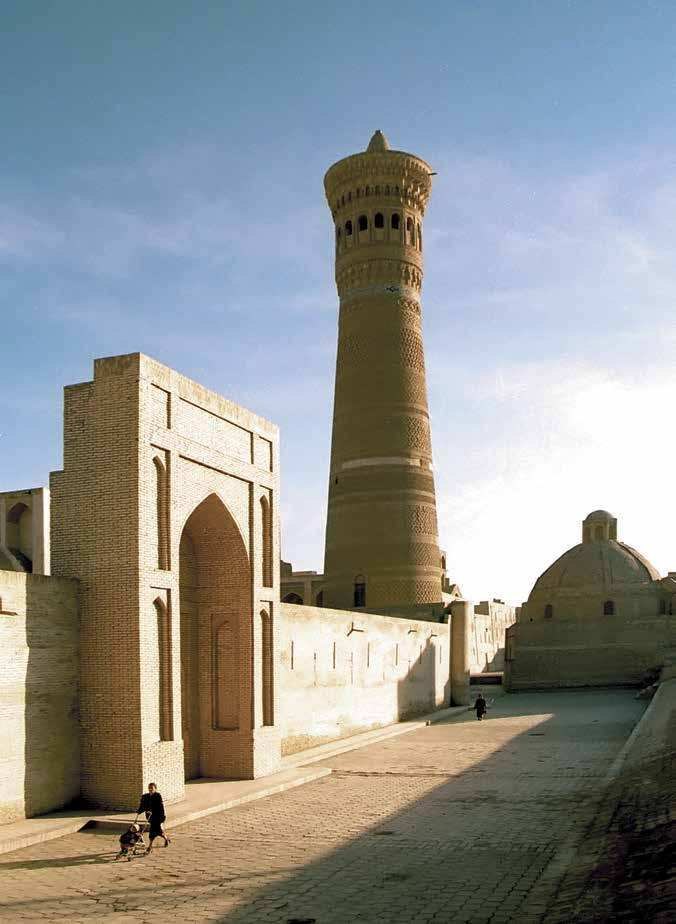
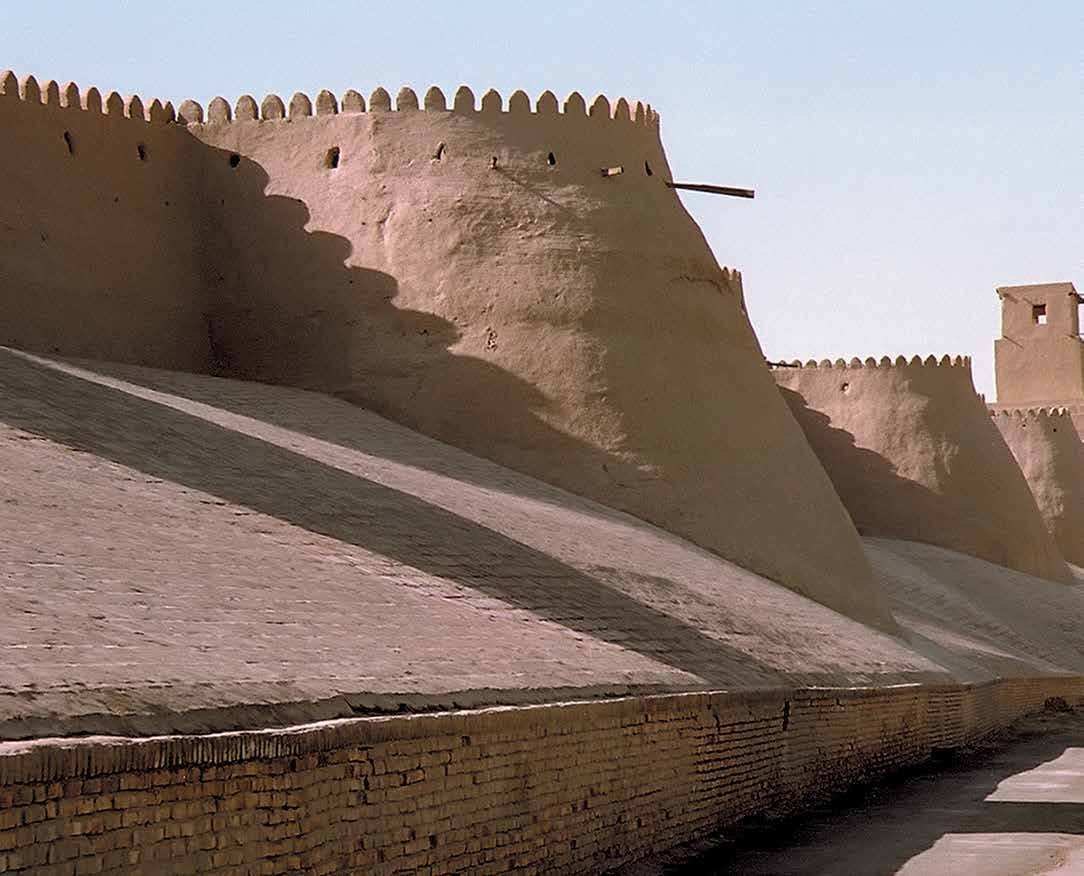
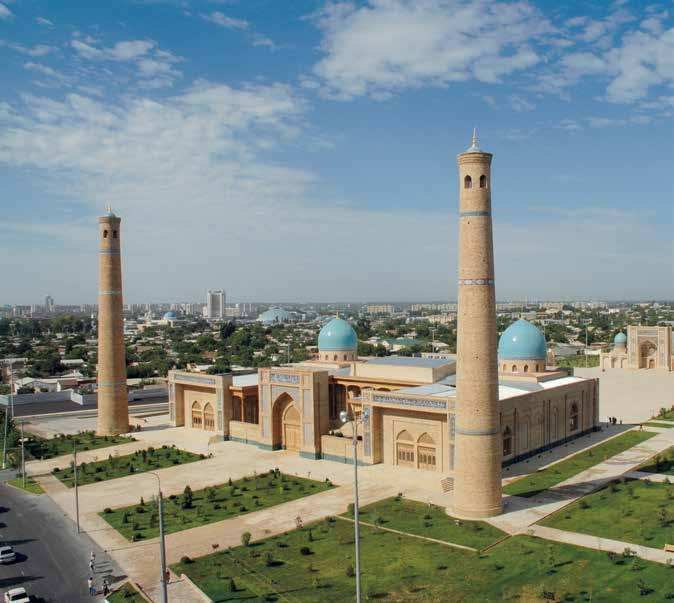
А. Арапов. «Исторические памятники Узбекистана» (SMI-ASIA, 2017). Фото: Ю. Кокозиди, А. Арапов, А. Зуев
Eleven cities - eleven different rhythms, landscapes and ways to understand the country.
From Samarkand squares and Khiva fortresses to the Tashkent metro, a museum in the desert and Buddhist Termez. Choose a city and open it through its places.
Samarkand's blue domes are younger than they look. The real city is nearly three thousand years old, and it lies right next door — under grassy mounds where the capital of Sogdiana once stood, until the Mongols arrived in 1220.
The Friday mosque was meant to be the grandest building in the Islamic world — a monument to a conqueror's might. And it was. Then it began to fall almost as soon as it was finished.
The color is unmistakable: deep turquoise against a bleached sky. But it isn't just beauty — behind it lie the chemistry of distant mines, the symbolism of water in a desert, and the imperial taste of an entire era.
Gur-e-Amir in Samarkand: the tomb of Tamerlane, the jade gravestone, the ribbed dome that inspired the Taj Mahal, and the legend of the 1941 opening of the grave. A Kvazar guide.
Registan Square history: the Ulugh Beg, Sher-Dor and Tilya-Kori madrasas, the mystery of the tigers on the portal, how to read the tilework, and how to visit. A deep Kvazar guide.
A narrow corridor climbing uphill between tombs, where turquoise closes in from both sides. Here lie Tamerlane's relatives — and here too, by legend, a beheaded king still lives.
One was built by Tamerlane's grandson, a scholar and stargazer — austere as a formula. The other, directly opposite, went up two hundred years later — opulent, excessive, indifferent to the canon. Between them lies a narrow lane and a whole change of eras.
Two centuries before Galileo, Tamerlane's grandson built an instrument as tall as a three-story house in Samarkand — and calculated the length of the year to within a minute. Then he paid for it with his head.
Clay walls on a twenty-meter mound, where Bukhara began. Behind them emirs were crowned, the treasury and the prison were kept — until one morning in 1920, aircraft appeared over the fortress.
It isn't on any of the great squares — it's tucked into the residential lanes behind Lyabi-Hauz. And yet these four mismatched towers are, more than anything, the "postcard" of Bukhara. A tiny building that out-argued every monument in the city.
Lyab-i Hauz in Bukhara: the 17th-century pool, the Kukeldash and Nadir Divan-Begi madrasas, the Khoja Nasreddin statue and the legend of one earring. The heart of the old city — a Kvazar guide.
Poi-Kalon in Bukhara: the Kalon Minaret (1127) that Genghis Khan spared, the vast Kalon Mosque, and the still-working Mir-i-Arab madrasa. History, legends and how to visit — a Kvazar guide.
No tiles, no gilding — just fired clay, laid so the wall changes its face through the day. Bukhara's oldest building survived the Mongols because it was buried in sand in time.
Most of Bukhara's monuments became museums long ago. These did not. Under domes raised five hundred years ago at the forks of the trade roads, people still sell carpets, knives and spices. This isn't a reconstruction of the Silk Road — it's the Silk Road...
Less than a square kilometre of clay streets, minarets and madrasahs — and yet the first UNESCO site in Central Asia. Behind these walls a khan once ruled, scholars prayed, and slaves were sold.
The Juma (Friday) Mosque in Khiva is a mosque with no dome, portal or courtyard — its roof is held up by 213 carved wooden columns dating from the 10th to the 19th century. What it is, why go, and why no two columns are alike. A Kvazar guide.
The turquoise giant by Khiva's western gate was designed to outshine everything in the Islamic world. The khan died, the work stopped — and the unfinished tower became the city's most recognisable landmark.
Kunya-Ark — the old citadel of the Khiva khans inside Itchan Kala: mint, arsenal, harem, prison and the kurinish-khana throne hall. The story of a fortress within a fortress, the Ak-Sheikh-Bobo bastion and what to see today. A Kvazar guide.
He was never crowned and never ruled. A simple leather-worker who became famous as an unbeatable wrestler, a healer, and the author of philosophical quatrains. Centuries later, a mausoleum with the largest dome in Khiva rose over his grave — and the city...
The Khiva khans had two palaces. Kunya-Ark — the old fortress-residence by the western gate. And Tash-Hauli — the new, ceremonial one by the eastern gate, built deliberately tangled: a stranger could never find his way to the ruler.
Amir Timur Square is the center of Tashkent: the equestrian statue of Tamerlane, Hotel Uzbekistan, the Navoi Theatre nearby. What to see around it, why the square outlived several eras, and why to go. A Kvazar guide.
Tashkent's main bazaar trades at the same crossroads it did a thousand years ago — but under a giant dome that became a monument in its own right. Here you buy spices and plov, and along with them the frozen spirit of two eras.
Travelers are often surprised: why is the capital of an ancient country so Soviet and so wide? The answer lies in one morning in 1966, when the city center collapsed in minutes. What you see today was built afterward. To understand the face of Tashkent, you...
Deep in old Tashkent, among the mud-brick houses that survived the earthquake, stands an ensemble built around a book almost fourteen centuries old. By tradition its pages bear the blood of a murdered caliph, and the manuscript's road ran through five...
This isn't a cozy park for strolling but the ceremonial square of a state. Here everything is a statement: a globe instead of a leader, an arch of storks at the entrance, an alley of memory for the war dead. The country's main square, as Uzbekistan wants to...
Tashkent's largest madrasah is named after the court title of a powerful vizier. Over four and a half centuries it has been a school, a caravanserai and a fortress — and, by a dark legend, a scaffold too.
The Tashkent Metro — the first in Central Asia and an underground museum: mosaics, marble and bas-reliefs. The Kosmonavtlar and Alisher Navoi stations, its history, why photography was banned until 2018, and how to make a mini-tour. A Kvazar guide.
Muynak was once a fishing port on the shore of the planet's fourth-largest lake. Today the water is dozens of kilometers of desert away, and rusty ships stand on the sand where the sea once lapped. It's a monument to one of the largest ecological...
On three hills near Nukus lies one of the oldest cemeteries in Central Asia. Here, by legend, the first man on earth is buried, and a half-ruined mausoleum is called the "Clock of the World": it's believed that one brick falls from its wall every year — and...
In a far-off city on the edge of a dried-up sea is kept the world's second-largest collection of Russian avant-garde. It was assembled by one man — an artist who drove around the villages, bought up forbidden paintings and hid them where Moscow wouldn't...
Kokand's main mosque was built by khans who dreamed of making their capital no worse than Samarkand and Bukhara. Its huge canopy is held up by dozens of carved wooden columns, and over the courtyard rises a slender brick minaret from which, by tradition...
The Khudayar Khan palace (Urda) in Kokand — the lavish residence of the last ruler of the Kokand Khanate. A hundred rooms, four minarets, and the fall of the dynasty within five years. A Kvazar guide.
Babur was born in Andijan and died thousands of kilometers away — in India, having founded the Mughal Empire. He never managed to return home. So earth from his grave was brought here, to the hill where he loved to walk and from which he once left his native...
The Jami complex in Andijan is the largest congregational mosque of the Ferghana Valley, with a 32-meter minaret. It survived the destructive earthquake of 1902. A Kvazar guide.
Ak-Saray in Shakhrisabz — the grand palace Amir Timur built in his home city to eclipse Samarkand. All that remains are two portal piers as tall as a modern building. A Kvazar guide.
Having lost his beloved son, Amir Timur built a memorial in his home city and prepared a crypt for himself nearby — he wanted to be buried here, in Shakhrisabz. But fate decided otherwise: the great conqueror rests in Samarkand, and the prepared crypt...
Beside the bulk of Ak-Saray hides a place of a completely different mood — a quiet courtyard where a mosque stands under a blue dome, and in the tombs rest Timur's mentor and his kin. If the palace spoke of might, this ensemble speaks of memory and reflection.
On the high bank of the Amu Darya, right by the border, stand the blue domes of the tomb of a Sufi sage whom people here respectfully call Termez-ota — "father of Termez." It's one of the chief shrines of southern Uzbekistan, grown from the modest cell of a...
In Termez, in southern Uzbekistan, the Buddhist monasteries of Fayaz-Tepa and Kara-Tepa survive from the Kushan era. People prayed to the Buddha here long before the arrival of Islam. A Kvazar guide.
Sultan-Saodat in Termez — the family necropolis of the Termez sayyids, descendants of the Prophet. An ensemble of mausoleums built from the 11th to the 17th century. A unique architectural school of southern Uzbekistan. A Kvazar guide.
A country is not a list of cities.
It is a sky for navigation.