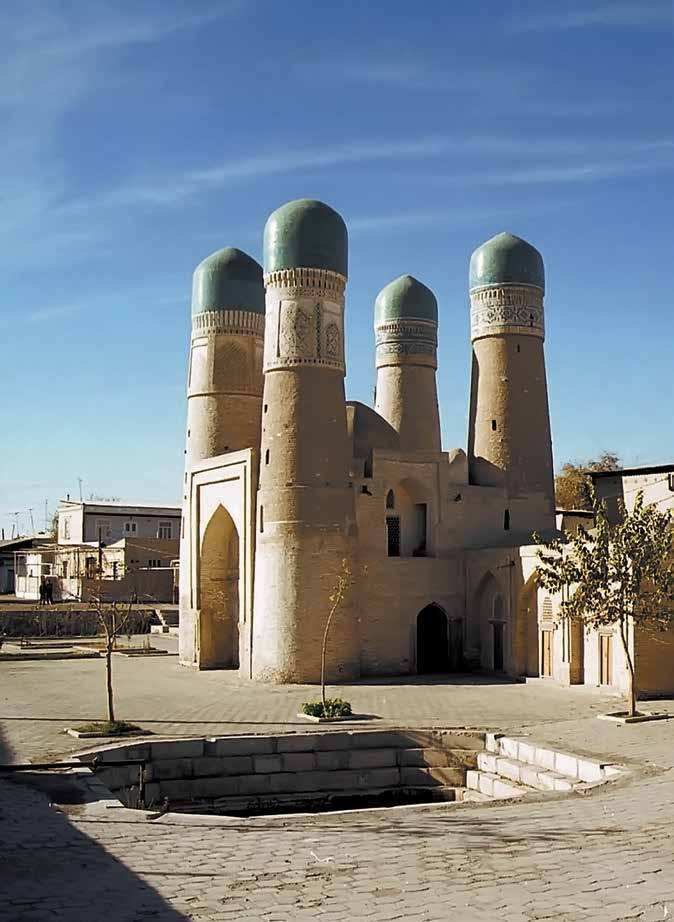
In the quiet residential quarters east of Lyabi-Hauz hides a building that has become just about the most reproduced image of Bukhara — Chor-Minor. The name is Persian for "four minarets," and that's the whole point: a compact structure crowned by four towers, no two alike. It is not the city's main, largest or oldest monument — but its strangeness made it a symbol. This guide covers what Chor-Minor is, why the towers differ, and whether it's worth seeking out in the back lanes.
What is Chor-Minor?
The main building with its four towers is a mosque with a fairly ordinary interior; what's unusual is the exterior composition. A courtyard with hujras (cells) once adjoined it, so the complex served both ritual and residential functions.
Chor-Minor breaks Bukhara's usual scale: next to the giant portals of Poi-Kalon it is an almost toy-like building — and that is exactly why it lodges in the memory.
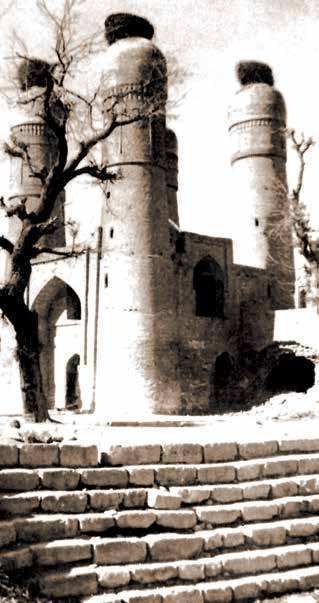
Why aren't the four towers the same?
The romantic version says the patron wanted to remind everyone who entered that, however different people and cultures may be, all are equal and live under one sky. That turns the building from mere architecture into a "message."
Treat this as part of Bukhara's oral tradition, not as proven fact. It makes Chor-Minor no less charming — on the contrary, the riddle adds to the pull.
Four towers — and not one resembles its neighbor. Perhaps a design about the equality of people, perhaps just a whim of taste. Bukhara is in no hurry to answer.
Who built Chor-Minor, and why?
The story that Niyazkul caught fire with the idea after encountering Indian architecture explains the building's "out-of-place" silhouette — it really does break with the Bukhara canon. It's a trace of the Silk Road: ideas traveled along with merchants.
The exact dating remains debated: archival documents hint at earlier mentions, so "1807" is best taken as the accepted but not undisputed date.
Is it a full madrasa or only a gatehouse?
For the traveler this means there's no need to look for a "big building behind the towers" — what you see is the main thing. The very ambiguity of its status is one more reason researchers love Chor-Minor.
How do you find Chor-Minor, and what should you know?
Tip: combine Chor-Minor with a walk from Lyabi-Hauz — it's close and logical on the route. And don't expect grandeur: the value here is in charm and oddity, not scale.
Frequently asked questions
What does "Chor-Minor" mean?
It's Persian for "four minarets." The building was named for its four towers topped with blue domes. Its official name is the Khalif Niyazkul Madrasa.
Why are the towers of Chor-Minor different?
They differ in decorative detail. By legend, the four mismatched towers symbolize the equality of the cardinal directions, cultures or religions under one sky. Historians regard these readings as a charming tradition rather than proven fact.
Who built Chor-Minor?
It is linked to Khalif Niyazkul, a wealthy patron said by tradition to have been inspired by the architecture of India. The traditional date is 1807, though there is evidence of earlier mentions of a madrasa on the site.
Is Chor-Minor a madrasa or a gate?
By one view it's the surviving entrance (gatehouse) of a larger lost madrasa; by another, a self-sufficient small complex. The main building with the towers is a mosque.
Where is Chor-Minor, and how long do you need?
In the residential lanes east of Lyabi-Hauz in Bukhara; you have to look for it. About 15–20 minutes is enough; it pairs well with a walk from Lyabi-Hauz.
Want to see Uzbekistan the way the people who live here see it?
Become a Kvazar Explorer →