Tashkent has an unenviable reputation: "the city with an airport." Travellers fly in, sleep, and rush off to the Registan, treating the capital as a transit zone with no face of its own. It's a mistake, but an understandable one — Tashkent doesn't sell itself as a postcard. Its charm lies elsewhere: the 1966 earthquake erased the old city, and in its place rose a vast Soviet experiment of metro-palaces and avenues, with a bazaar and shrines surviving alongside. You can't "see Tashkent" in a day, but you can catch its character — and decide whether you'll come back for a second day.
Is it even worth stopping in Tashkent?
The logic is simple: Samarkand and Bukhara show Uzbekistan's past, Tashkent its present. After the 1966 earthquake the city was rebuilt as a model Soviet capital, and that layer — avenues, mosaics, underground metro palaces — is nowhere in the country as vivid. Whoever skips Tashkent sees a museum but not a country. Where to go next and why Tashkent is a logical starting point is covered in the where-to-go-first guide and the comparison Tashkent or Samarkand.
Samarkand shows what Uzbekistan was. Tashkent shows what it is now. To skip the capital is to see a museum instead of a country.
How to build a one-day route?
The main principle is not to try to "do everything." In a day you can realistically live two contrasting Tashkents: the religious-bazaar old town and the grand modernist Soviet city. It's easiest to start the morning with Hazrati Imam and Chorsu, while the bazaar is cool and genuinely busy, sit down for plov by noon, and give the afternoon to the metro and the avenues, where the heat is easier underground and in the shade. Keep exact addresses and hours offline — how to set up connectivity and maps is in the internet and SIM guide.
What to see in old Tashkent?
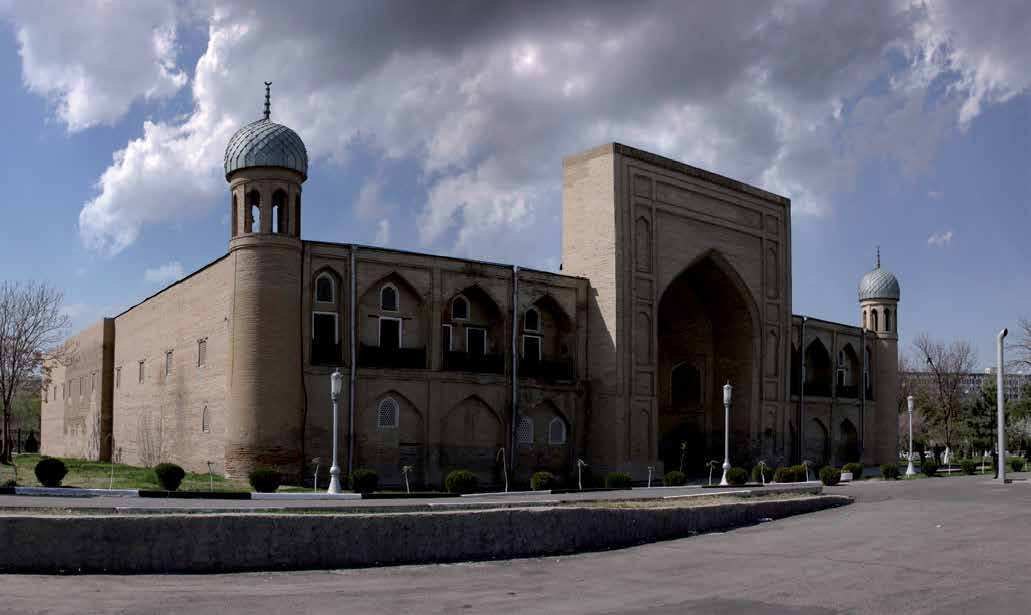
The earthquake nearly erased old Tashkent, but these two places survived and hold its spirit. Hazrati Imam is a working shrine, calm and stately, requiring modest dress; here you feel a religious Uzbekistan with no tourist polish. Chorsu is the opposite: hum, colour, smells, rows of spices in mounds and heaps of melons. Step inside under the dome, climb to the gallery for the view from above, and be sure to try something from a vendor — that's the living city. What to actually bring home from the bazaar is in the Chorsu guide.
What's interesting about the Soviet capital?
If the old city is the past, the metro and avenues are a frozen utopia. Kosmonavtlar is dedicated to space exploration and built like a flight through the blue; Alisher Navoi looks like an underground madrasah, with domes and Islamic ornament. Riding a couple of stations purely for the interiors is a pleasure in itself, and almost free. Above ground, walk Amir Temur Avenue and the squares to grasp the scale of the city's Soviet rebuild. A detailed route through the most beautiful stations is in our metro guide.
Where to eat during the day?
Food in Tashkent isn't a pause in the route but part of it. Uzbek plov is on UNESCO's intangible heritage list, and it's best eaten where you can see the kazan. Besh Qozon is a spectacle: plov is cooked over wood in giant cauldrons in the courtyard, and the hall serves fast. But don't fixate on one address: at Chorsu and in small cafes plov is cheaper and no less real. The key rule is not to be late: by evening, fresh plov can be sold out. A full breakdown of where to find the best plov and how to avoid the tourist version is in the plov guide.
What to fit in on a layover?
If you have only a few hours in Tashkent between flights, don't spread yourself thin — pick one pole. A short layover (4–6 hours counting the airport run both ways): the metro as a museum plus plov near a station gives you a "taste" of the city without the risk of being late. A long layover (6–10 hours): add Hazrati Imam and Chorsu as a single block, since they're close. Keep a buffer for the trip back to the airport: use an app-based taxi to avoid haggling and see the price up front — how it works is in the transport guide. And remember mobile internet for maps and taxis — without it a layover turns into stress.
Common questions about a day in Tashkent
Is one day enough for Tashkent?
For "getting the city's character" — yes: in a day you can realistically see both its faces, old (Hazrati Imam, Chorsu) and Soviet (metro, avenues), and have plov for lunch. For museums, the evening city and unhurried walks you need a second day. On a layover, focus on one pole so you don't miss your flight.
What should I see first?
Two must-sees: the Hazrati Imam complex (the religious heart of the old city, with an ancient Qur'an manuscript) and Chorsu bazaar under its turquoise dome. Add a metro ride for the museum stations (Kosmonavtlar, Alisher Navoi) and plov for lunch before noon. That's enough for a whole impression of the city.
Can I take photos in the metro?
Yes, since 2018 photographing stations has been officially allowed — the metro used to count as a strategic site and photos were banned. Now tourists freely shoot the interiors; just follow the posted signs and don't photograph security. The fare is flat, with payment by card, QR or ATTO at the turnstile.
Where and when to eat plov?
Better before noon: the famous plov houses cook it in batches in large cauldrons, and popular kinds sell out by lunch. The main address is Besh Qozon by the TV tower, but bazaar plov at Chorsu and small cafes are just as good and cheaper. Plov is on the UNESCO heritage list — try it where you can see the kazan.
How to get around the city in a day?
Metro — for long hops between districts: fast, cheap, and the stations themselves are worth a look. An app-based taxi (like Yandex Go) — for last stretches, luggage and the airport run: the price is shown up front, no haggling. Taxis and maps need mobile internet, so set up a SIM or eSIM in advance.
Want to see Uzbekistan the way the people who live here see it?
Become a Kvazar Explorer →