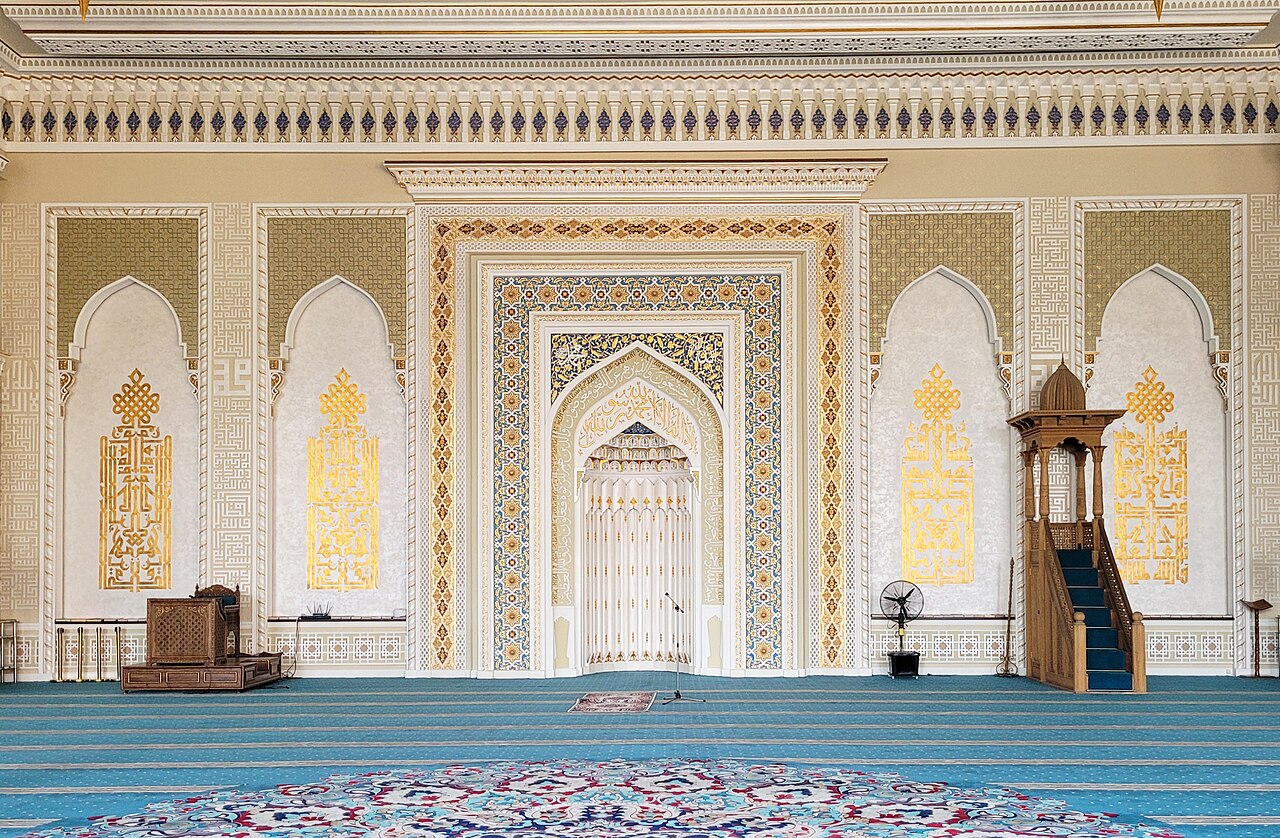
Most people come to Tashkent for the old town and the bazaar, unaware that in March 2026 a building opened next to Hazrati Imam that changes the meaning of the whole trip. The Center of Islamic Civilization is not "another sight" but a framing idea: it explains where the region that gave the world mathematicians and astronomers came from, and how the country tells its own heritage today. This guide covers what is inside, how to get in, and why to see it together with the neighbouring Hazrati Imam.
What is the Center of Islamic Civilization in Tashkent?
The centre took about eight years to build and, on opening, immediately made international lists of the year's most anticipated museums. It is not "another mosque" or a classic local-history museum, but an attempt to gather the whole Islamic civilisation that took shape on these lands into one building — with modern technology, rare artefacts and architecture that itself tells the country's story.
The location is deliberate: the centre stands right beside Hazrati Imam — a quarter where pilgrims have come for centuries. The result is a dialogue: living faith next to the museum interpretation of its history. So it makes sense to see them together, in one visit; how to fit this into a route is in our Tashkent in two days guide.
What is inside and what must you see?
The Uthman Quran is the heart of the whole building. Its history is itself a journey: the manuscript is linked to a path from Baghdad to Samarkand (where, by a widely held account, Amir Timur brought it), then to St Petersburg and back to Tashkent in 1924. Today it is here again, in a specially designed hall.
The interactive galleries present the work of golden-age scholars — al-Khwarizmi, Ibn Sina and others. These are world figures born on the lands of modern Uzbekistan: their contributions to mathematics, astronomy and medicine are shown through modern technology rather than glass cases. Allow at least 3–4 hours for all of it — the centre cannot be covered in an hour.
Hazrati Imam next door is faith that is lived. The Center of Islamic Civilization is an attempt to explain what that faith gave the science and culture of the world. Two buildings, two different truths about one place.
What is interesting about the building itself?
The idea of the portals is for one building in the capital to absorb the architectural traditions of the whole country — a kind of visual table of contents for Uzbekistan. The dome is dramatically illuminated in the evening, and many come specially at sunset: the centre is open late, and the lit building is a sight of its own, worth planning an evening visit for.
How to plan a visit: tickets, time, rules?
Practical details that save frustration: arrive with time to spare before your slot, leave large bags in the locker room, and do not count on "popping in for half an hour" — the format is built for an unhurried visit. If you want the illuminated dome, plan an evening visit, as the centre is open late. The exact tour format and times are best confirmed in advance with a tour operator or on site — the centre is new and the rules are still settling.
Is it worth going — and for whom?
The centre works best as a framing idea before a trip across the country, or as its final note: having seen the golden age of science and the Uthman Quran here, you look differently at the Registan, Bukhara and Khiva. What to see nearby and how to fit the capital into the wider plan is in our Tashkent in two days and Uzbekistan in 7 days guides.
Frequently asked questions about the Center of Islamic Civilization
When did the Center of Islamic Civilization in Tashkent open?
The centre opened in March 2026 next to the Hazrati Imam ensemble in the old part of Tashkent. Construction took about eight years, and on opening the complex made international lists of the year's most anticipated museums. It is the most notable recent addition to Tashkent's tourist map.
What is kept in the Center of Islamic Civilization?
Its main treasure is the Uthman Quran, one of the world's oldest surviving Quran manuscripts, inscribed on UNESCO's Memory of the World register, in a dedicated Quran Hall. Beyond it are interactive galleries on the golden age of science with the work of al-Khwarizmi, Ibn Sina and others, plus rare manuscripts and artefacts.
How much time should you allow for the Center of Islamic Civilization?
At least 3–4 hours: the complex is vast (several floors, a total area of over 42,000 sq m), the guided tour lasts about two hours, and the exhibitions reward an unhurried visit. You cannot cover the centre in an hour, so plan it as a separate major item of the day.
Do you need to book tickets in advance, and are there visiting rules?
It is best to book ahead: entry is by timed slot, often as part of a roughly two-hour guided tour, and at peak times there are many visitors. A ticket is for one person, with no re-entry. You cannot bring your own water — it is bought on site. Dress modestly (shoulders and knees covered), women will want a scarf, and flash photography is not allowed.
Can you combine the Center with the Hazrati Imam complex?
Yes, and it is the most logical plan: they stand side by side and together give the full 'Islamic' layer of Tashkent — the living shrine of Hazrati Imam and the museum-form intellectual history in the Center. Allow most of a day for both together.
Want to see Uzbekistan the way the people who live here see it?
Become a Kvazar Explorer →