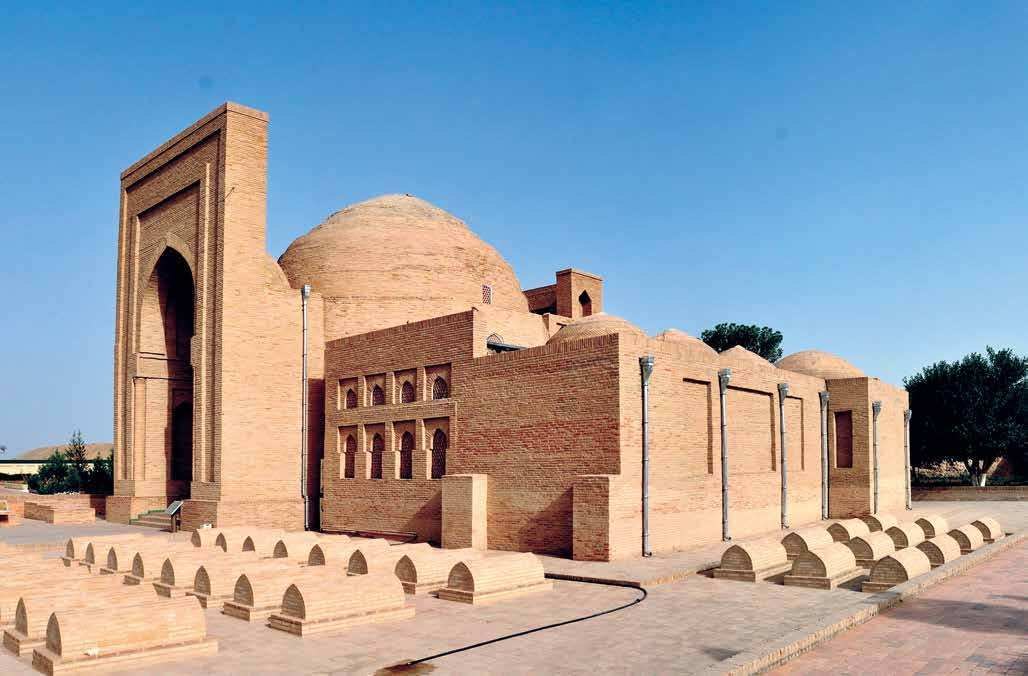
If the Buddhist monasteries show the most ancient layer of Termez's history, the Al-Hakim at-Termizi mausoleum tells the next chapter — the Islamic and Sufi one. This complex on the bank of the Amu Darya took shape over centuries around the grave of one man: a theologian and mystic whose name became almost a synonym for the city itself. For Muslims it's a venerated shrine; for the traveler, a chance to understand what medieval Termez lived by.
Who was Al-Hakim at-Termizi?
The epithet "Hakim" means "sage," and a reputation as the "sage of Termez" attached to him. By legend, spiritual revelation came to him while still a child. His writings were studied far beyond Central Asia and left a marked trace on Islamic mystical philosophy. It was the scale of this figure that turned his grave into a place of pilgrimage.
Why is he called the "father of Termez"?
Such veneration is typical of the Islamic culture of Central Asia, where the graves of saints became centers of the spiritual life of whole regions. Pilgrimage to the Al-Hakim at-Termizi mausoleum is considered a good and significant deed. For Termez itself, this tomb is not just an architectural monument but the heart of its Islamic identity.
What does the complex consist of?
So the complex took shape over almost a thousand years, and its buildings read out different eras — from the pre-Mongol period to the late Middle Ages. The blue domes of the restored mausoleum on the high bank of the Amu Darya are visible from afar and serve as a kind of calling card of Old Termez. It's a living monument, where architecture is inseparable from spiritual tradition.
What are the underground chillakhanas?
These underground spaces are one of the most atmospheric parts of the complex. The coolness and silence below ground contrast with the hot southern sun above and create a special sense of concentration. Descending into the chillakhana lets you feel the essence of Sufi practice: a turn inward, a withdrawal from the world for the sake of spiritual search.
The city called him its father. The sage's name and the name of Termez have been inseparable ever since.
How did different eras meet here?
This turns the mausoleum into a kind of knot of the city's history. Nearby are the Buddhist Fayaz-Tepa and Kara-Tepa, and a little farther the Sultan-Saodat necropolis of the Termez sayyids. Together they show Termez as a place where religions didn't simply replace one another but layered up, leaving monuments of each era. In few places in Central Asia is this layering so clearly visible.
How do you visit the mausoleum?
It makes sense to combine a tour of the complex with Termez's other monuments — the Buddhist Fayaz-Tepa and Kara-Tepa and the Sultan-Saodat necropolis — to see the city in its historical fullness. For many travelers, it's precisely the combination of Buddhist and Islamic heritage that makes Termez one of the most unusual destinations in Uzbekistan.
Frequently asked questions about the Al-Hakim at-Termizi mausoleum
Who was Al-Hakim at-Termizi?
A Sufi theologian and thinker born around 824, one of the early theorists of Sufism and the author of many religious-philosophical works. The people call him the "father of Termez."
Why is he called the "father of Termez"?
The respectful epithet Termez-ota reflects his role as the most celebrated native and spiritual patron of the city. The sage's name is closely tied to Termez itself.
Is this the same person as the hadith collector at-Tirmidhi?
No. The Sufi Al-Hakim at-Termizi is often confused with the hadith scholar Muhammad ibn Isa at-Tirmidhi — these are two different people with similar names.
What does the complex include?
The mausoleum with blue domes, a commemorative mosque of the 11th–12th centuries, a khanaka of the 14th century, a room for reading the Quran, and underground chillakhanas, with a necropolis of venerated Sufis nearby.
What is a chillakhana?
A room for solitary prayer and fasting. Here the chillakhanas are located deep underground and resemble caves; by tradition, the sage himself lived and prayed in such a cell.
Can you visit the mausoleum freely?
The complex is in the border zone by the Amu Darya, so a permit or a guide may be required. It's a working shrine — you must observe the rules of conduct and modesty in dress.
Want to see Uzbekistan the way the people who live here see it?
Become a Kvazar Explorer →