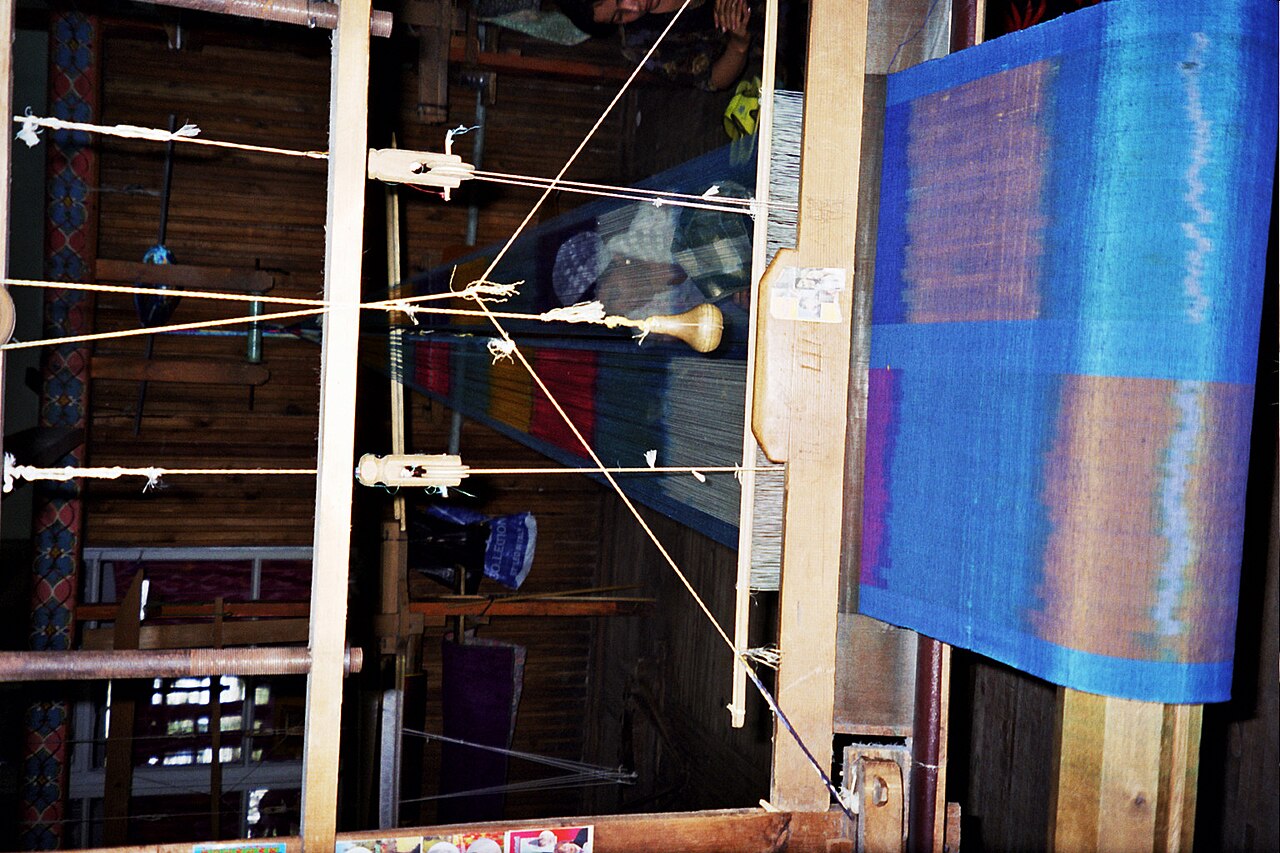
Tourists come to Uzbekistan for the past — for the dead stones of great ensembles. Margilan offers the opposite: a craft that never stopped. This city in the Fergana Valley has woven silk for more than two thousand years, and its patterned khan-atlas was loaded onto camels heading west when Samarkand was still young. Today its workshops still unwind the cocoon, dye the thread with ash and plants, and weave by hand — the same motions, the same looms. This guide explains what ikat is, where to go for real silk, and why Margilan is a working craft town, not a museum of one.
Why go to Margilan specifically?
That's the whole point of the detour into the Fergana Valley. Samarkand and Bukhara are showcases of a great past; Margilan is a workshop where the past hasn't ended. Here a grandmother threads a loom and tells how her family hid the pattern books during Soviet collectivization, while a weaver in his twenties leaves a tech career to revive his grandfather's pattern. Culture here is still in daily use, in the most literal sense. Where else the Fergana Valley leads and why it's wrongly skipped is in our overview of what to see beyond Samarkand.
Other Uzbek cities show what the civilization was. Margilan shows how it breathes — in the sound of a loom that hasn't fallen silent in two thousand years.
What are ikat and khan-atlas?
To understand ikat is to understand why it's so prized. It's one of the most demanding textile techniques in the world: the master must "see" the future pattern while it's still a bundle of threads, tie and dye them precisely, and only then weave — the slightest miscalculation shifts the design. Hence the characteristic soft "blur" of the edges by which ikat is recognised. Pure silk is called khan-atlas, silk with cotton is adras, and there's also a blended beqasam. Importantly, the Margilan pattern is its own school, not to be confused with other regional traditions. This is part of our editorial principle of distinguishing craft schools rather than lumping everything into "Uzbek ornament."
What does the Yodgorlik factory show?
It's the best starting point because Yodgorlik shows the process whole and clearly. A tour usually starts at the old mulberry tree — feed for the silkworms — and moves through the stages: boiling cocoons and drawing the thread, spinning, dyeing with ash and plant pigments, weaving the coloured ikat on wooden looms. The factory was founded in 1972 and rests precisely on handwork, which is what makes it unique. Come in the morning (8–9 a.m.), when all the sections are active. English-speaking guides are available. The pattern and technique here are specifically Margilani, as the masters themselves note.
How do the private workshops differ?
If Yodgorlik shows scale and process, the private workshops show the person at the loom. There, a two-metre length of premium khan-atlas — enough for one traditional robe — can take three weeks to weave, and the price reflects the labour only in part: here craft is valued as inheritance, not commodity. This is the most honest way to see a living Margilan. The downside is that such workshops are hard to find on your own — a guide or cultural tour with relationships among the weaving families helps. The names of the city's master weavers are well known, and locals will gladly point the way.
What and where to buy?
Buy fabric in three places. The shop at Yodgorlik is a reliable choice with a guarantee of origin: scarves, lengths, finished khan-atlas and adras clothing. Private workshops — for one-off, signature pieces with a story. The local bazaar (a Sunday textile market) — for immersion, bargaining and mountains of cloth, but here you need an eye: check whether it's silk or a blend, and haggle. It helps to distinguish: khan-atlas is pure silk (pricier, lighter, with a characteristic sheen), adras is silk with cotton (denser, cheaper). Paying is safer in cash som, especially at the bazaar and in workshops — how money and cards work is in the cards guide. And mind your luggage: a length of cloth travels easily, but fragile items are best protected.
How to get to Margilan?
Logistics is the only reason the valley gets skipped, and wrongly: the trip repays it. Train to Kokand, then a minibus, is the most balanced route for time and cost; the flight is faster but schedule-bound. Margilan is often combined into one route with Kokand and Rishtan (ceramics) — the valley's classic craft loop. Summer here is hot (over 40 °C), so spring and autumn are more comfortable and livelier at the bazaars. How to get around the country generally is in the transport guide, and connectivity in the valley in the internet and SIM guide.
Common questions about Margilan
What is khan-atlas and how does it differ from adras?
Khan-atlas ("royal silk") is Margilan's pure-silk ikat fabric, with a characteristic sheen and blurred pattern. Adras is a silk-and-cotton blend: denser, cheaper, less shiny. Both are made by the ikat technique, where threads are dyed before weaving. When buying it's worth checking the composition, especially at the bazaar, where blended cloth also appears.
Is the Yodgorlik factory worth visiting?
Yes, it's the best starting point: it shows the whole handmade cycle — from cocoon and thread-drawing to dyeing and weaving. The factory is on the UNESCO safeguarding register. Come in the morning (8–9 a.m.), when all the sections are active; there are English-speaking guides and a shop with a guarantee of the fabric's origin.
Are private workshops better than the factory?
Not better, but more intimate. At the factory you see the scale and process; in a family workshop, the person and the story: the master walks you through the stages and explains the pattern's meaning. There are one-off signature pieces there, but they're harder to find on your own — a local guide or cultural tour with ties to artisan families helps.
How do you get to Margilan from Tashkent?
Easiest is the Afrosiyob to Kokand (~2.5 h), then a minibus or taxi to Margilan; or a flight Tashkent–Fergana (~50 min) and a taxi. By road it's about 5–6 hours over the Kamchik pass. Margilan is often combined into one route with Kokand and Rishtan. Best time is spring and autumn.
Is silk cheaper here than in Samarkand?
Usually yes: Margilan is the place of production, so fabric is often cheaper here than in the tourist shops of the big cities. But prices depend on the type of cloth, the pattern's complexity and the handwork, and the rate floats, so we don't quote specific sums. Paying is safer in cash som, especially at the bazaar and in workshops.
Want to see Uzbekistan the way the people who live here see it?
Become a Kvazar Explorer →