Andijan is the largest city of the Ferghana Valley and one of the oldest in Uzbekistan, yet it rarely makes the tourist routes. That's a pity: it's the birthplace of Zahir-ud-din Muhammad Babur — poet, commander and founder of the Mughal Empire, great-grandson of Amir Timur. Andijan's main "exhibit" isn't a building but a man and his story, and once you understand that, you see the city differently. Let's look at what to see here, and why.
How is Andijan different from the other cities of the valley?
The city is split by the railway into an old part (going back to antiquity) and a new town laid out at the end of the 19th century. After the Kokand Khanate was annexed by the Russian Empire in 1876, Andijan became part of it; the destructive earthquake of 1902 completed the loss of the old fabric. So, as in Tashkent, it matters more to understand the story of the place than to tick off sights.
Andijan preserves not stones but a name. A city that produced the founder of the Mughal Empire is a monument in itself.
Who was Babur, and what does Andijan have to do with him?
In the Babur park there's a garden zone in the spirit of the gardens he loved, a house-museum with an exhibition of his life and his descendants, and a symbolic tomb to which earth was brought from his real grave in Afghanistan. A cable car lifts you to a hill with a panorama of the city. For the traveler it's the best place to understand who Babur was and why Andijan is so proud of him.
What is the Jami complex?
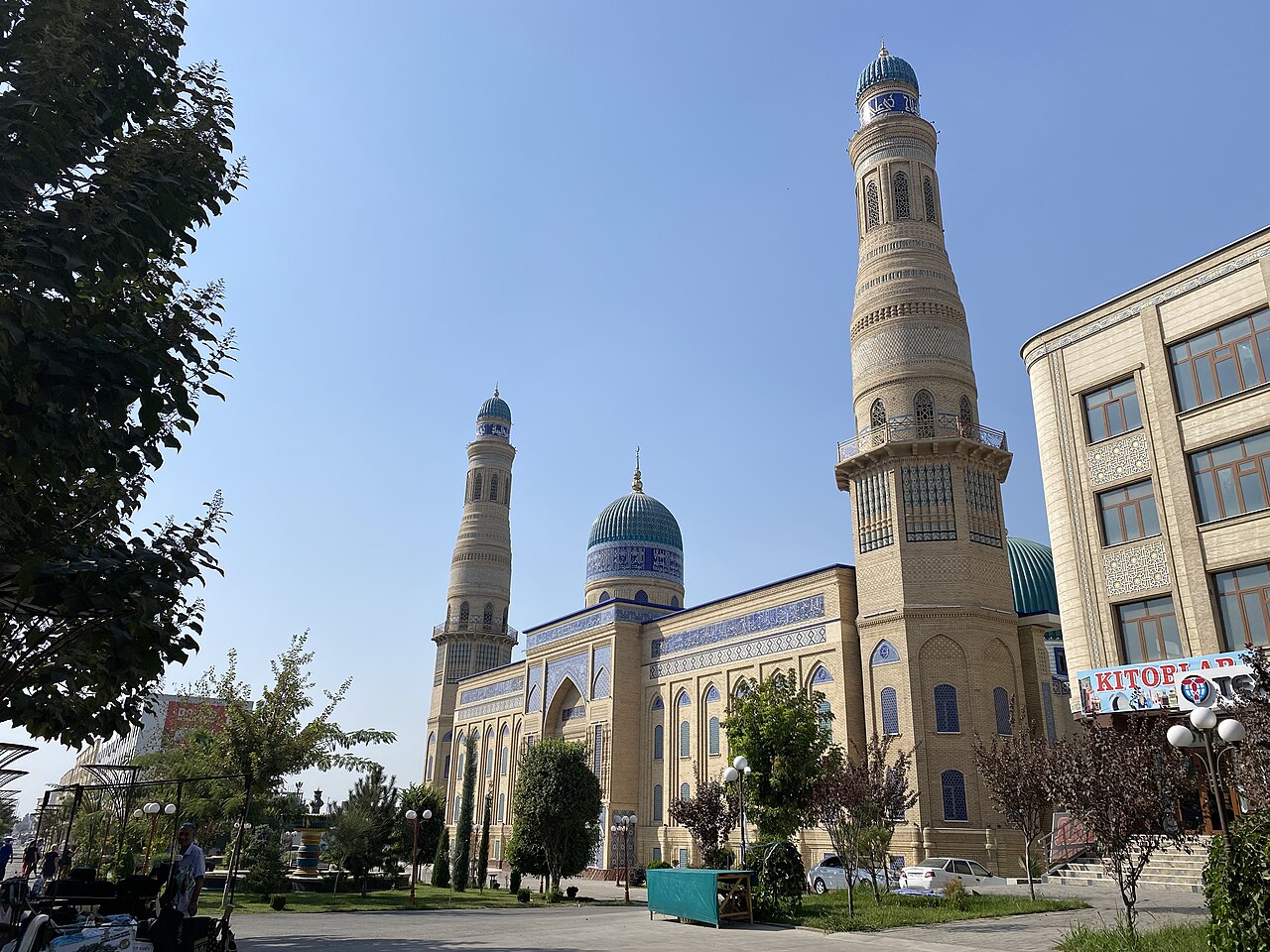
Against the scarcity of old monuments, the Jami complex is especially valuable: it gives a sense of how pre-revolutionary Muslim Andijan looked. Beside it are the old-town quarters and the bazaar, pleasant to walk to feel the living, non-touristy city.
What else is there to see in Andijan?
Andijan is a good "base" for getting to know the eastern part of the Ferghana Valley. From here it's convenient to make day trips around the region. For the cuisine of the valley — Ferghana plov, devzira rice, Kokand halva — see our piece on the food of the Ferghana Valley.
How much time do you need, and how do you get there?
Practical topics — transport, season, money — we keep in the Atlas section. The best time for a trip to the valley is spring and autumn: summer in Ferghana is hot. Onward through the valley, it makes sense to head to Margilan for silk and to Ferghana as the transport hub.
Frequently asked questions about Andijan
What is Andijan famous for?
Above all, for being the birthplace of Babur — poet, commander and founder of the Mughal Empire. Andijan is also one of the oldest cities in Uzbekistan and the largest in the Ferghana Valley, once a center of the Silk Road, silk-weaving and horse-breeding.
What is there to see in Andijan in one day?
The Babur park and house-museum with the "Babur and World Culture" museum, the Jami complex (mosque, minaret, madrasa — the largest in the valley), the old town, the bazaar and the regional museum. That's enough to get to know the city.
Why are there so few ancient monuments in Andijan?
The city is very old, but the historic fabric suffered from age and the destructive earthquake of 1902. So Andijan is interesting above all as the birthplace of Babur and through its history, rather than through abundant surviving architecture.
Is Andijan worth visiting?
Yes, if you're interested in history and the Ferghana Valley. Andijan isn't a "museum" city like Bukhara, but it gives a different angle on the country and is handy as a base for trips around the valley: Margilan, Ferghana, Kokand, Rishtan.
Want to see in Andijan not a "pass-through town" but the home of a man who changed history?
Become a Kvazar Explorer →