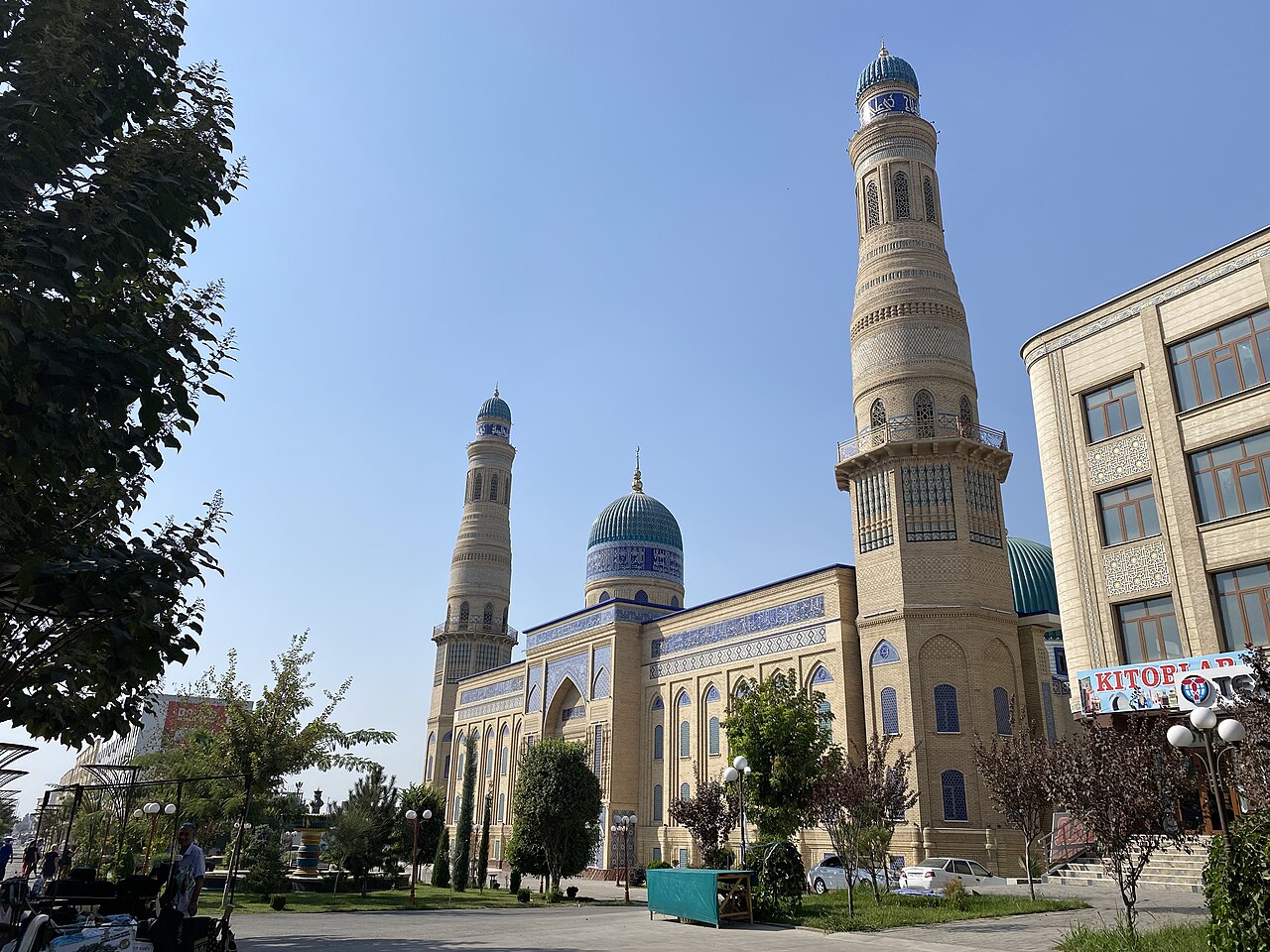
If the Babur park keeps the memory of a great native son, the Jami complex is the material heart of historic Andijan. Built at the end of the 19th century, it became the largest religious ensemble in the whole Ferghana Valley. And, most valuably, it survived the catastrophe that changed the city: the destructive earthquake of 1902. The surviving mosque and minaret are not only a beautiful sight but a symbol of Andijan's resilience.
What is the Jami complex?
The appearance of so large a complex was tied to the city's growing importance: in that era, the status of a city was conferred on settlements with a congregational mosque, and each strove to outdo its neighbors in the grandeur of its own. The Andijan Jami became the largest in the whole Ferghana Valley — the city's bid for primacy in the region.
How large is this ensemble?
The mosque's main facade, in the Muslim tradition, faces Mecca. The long colonnade of the iwan and the extended facade create a sense of monumentality unusual for most buildings in the valley. The woodcarving on the columns is a work of art in itself, worth examining the iwan up close for.
What is the minaret famous for?
The minaret is both the main landmark and a symbol of the city. Its height is no accident: it underscored the status of the Andijan congregational mosque as the largest in the valley. The fact that it was the minaret, together with the mosque, that survived the 1902 earthquake gave it an added symbolic meaning — as a surviving witness of old Andijan.
What happened in 1902?
This catastrophe largely shaped the appearance of modern Andijan: a significant part of the city had to be rebuilt. Against the mass destruction, the surviving Jami complex took on a special value — as a visible thread linking today's city with its pre-revolutionary past. So the monument is treated here with particular respect.
The 1902 earthquake flattened the city — but the mosque and its 32-meter minaret remained standing.
What can you see today?
A walk through the complex lets you appreciate both the scale and the finesse of Ferghana craftsmen: from the long row of arches to the carved wooden columns and the lattices with geometric pattern in the madrasa. For the traveler, it's the best place in Andijan to feel the atmosphere of the city in the era of the Kokand Khanate and tsarist times.
How do you get to the complex?
Seeing the complex with the museum takes about an hour. It makes sense to combine it with the Babur park on the Bagh-i-Shamol hill — the two main points of Andijan. And the whole city fits conveniently into a route through the Ferghana Valley with Ferghana, Margilan and Kokand, to see the region as a whole.
Frequently asked questions about the Jami complex
What does the Jami complex include?
A congregational mosque, a minaret and a madrasa, plus the regional literary-art museum on the grounds. The ensemble occupies about 1.5 hectares.
When was it built?
Around 1883–1890, at the end of the 19th century, on the site of an earlier mosque.
How tall is the minaret?
32 meters — the tallest minaret in the whole Ferghana Valley. It stands on an octagonal base with a gallery.
Is it true the complex survived the earthquake?
Yes. During the destructive 1902 earthquake that destroyed most of Andijan, the mosque and minaret on the whole stood firm, although the side wings of the madrasa collapsed.
Is it a working mosque?
Yes, the Jami congregational mosque is active. When visiting, dress modestly and respect those at prayer.
How do you get there?
The complex is in the center of Andijan. The city is reached from Ferghana or from Tashkent (by air or via the Kamchik pass).
Want to see Uzbekistan the way the people who live here see it?
Become a Kvazar Explorer →