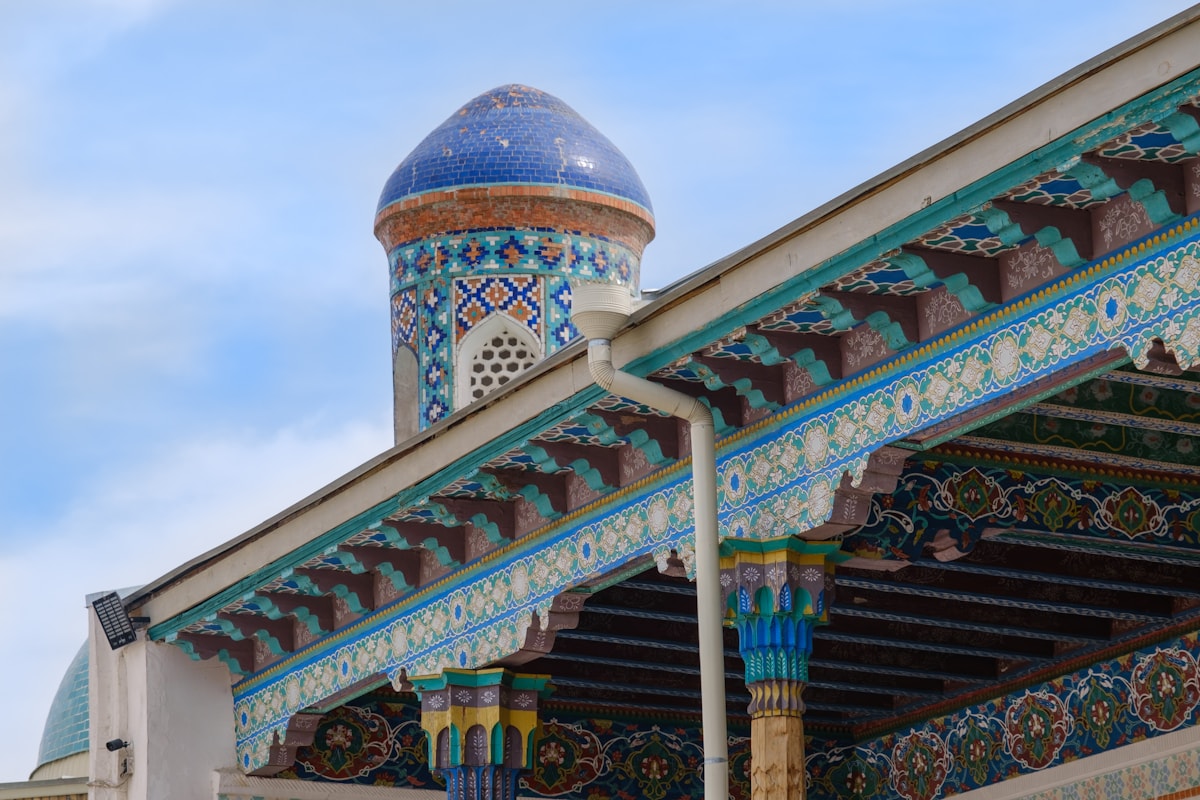
If the Khudayar Khan palace tells of the secular power of the Kokand Khanate, the Jami mosque tells of its spiritual life. It's the capital's congregational (Friday) mosque, founded at the start of the 19th century on the city's main square. A spacious iwan on dozens of columns, ornate carving and a tall minaret make it one of the finest monuments of Ferghana craftsmanship — and a place that contemporaries ranked alongside the architecture of Samarkand and Bukhara.
What is the Jami mosque in Kokand?
The word "jami" (or "jomi") means "congregational," "Friday" — such mosques were the main ones in every major city of the Islamic world. In Kokand, the Jami became the spiritual center of the khanate's capital. Contemporaries noted the beauty and nobility of its architecture, ranking the monument alongside the celebrated buildings of Samarkand and Bukhara.
Who built the mosque, and when?
So the mosque was built during the heyday of the Kokand Khanate, when its rulers sought to adorn the capital with monumental structures. A madrasa operated at the mosque, with classes held in its hujras right up to 1918. The mosque itself served as a place of prayer for citizens and, in Soviet times, temporarily lost that function, but later became active again.
What is the iwan of the mosque famous for?
Wooden columned iwans are a characteristic feature of Central Asian mosques, but in the Jami this one reaches a particular scale. The fine carving in wood and ganch, the rhythm of the long rows of columns, create a sense of lightness and space. It's for this iwan and the finesse of its finish that the Jami mosque is valued as a model of mature Ferghana craftsmanship.
What's special about the minaret?
From the top of the minaret, by accounts, a view opened over all of Kokand. Spare and soaring, it serves as the vertical dominant of the whole complex and is easily recognized against the city. The Jami minaret is one of Kokand's symbols and a frequent subject of travelers' photographs.
Contemporaries ranked the beauty of the Jami alongside the monuments of Samarkand and Bukhara — the highest praise for a city of craftsmen.
Why is the mosque important for Kokand?
For the traveler, the Jami is an essential point in Kokand, complementing the Urda palace. If the Urda astonishes with its splendor and tragic fate, the Jami wins you over with noble restraint and mastery of detail. Together they form a complete portrait of a city that was once the capital of its own state.
How do you get to the mosque?
Seeing the mosque takes about half an hour to an hour. It pairs naturally with the Khudayar Khan palace — the two main points of Kokand. And the whole city fits into a route through the Ferghana Valley with Margilan and Ferghana, to see the region as a whole.
Frequently asked questions about the Jami mosque
What does "Jami" mean?
"Jami" (jomi) means "congregational," "Friday" mosque — the main mosque of a city, where the citywide Friday prayer is held.
Who built the mosque?
Construction began under Alim Khan around 1805, and it was mainly built in the 1810s–1820s under the Kokand ruler Umar Khan.
How many columns are in the iwan?
By common accounts, the mosque's huge iwan is supported by about 98 carved wooden columns with "stalactite" capitals.
How tall is the minaret?
About 22 meters. It's built of fired brick, topped with a faceted dome, with a spiral staircase inside.
Is it true people were thrown from the minaret?
It's a folk tradition with no documentary confirmation. The minaret's main function was the call to prayer; grim legends surround many old minarets.
How do you get there?
The mosque is on Chorsu square in the center of Kokand. The city is reached from Ferghana or from Tashkent via the Kamchik pass.
Want to see Uzbekistan the way the people who live here see it?
Become a Kvazar Explorer →