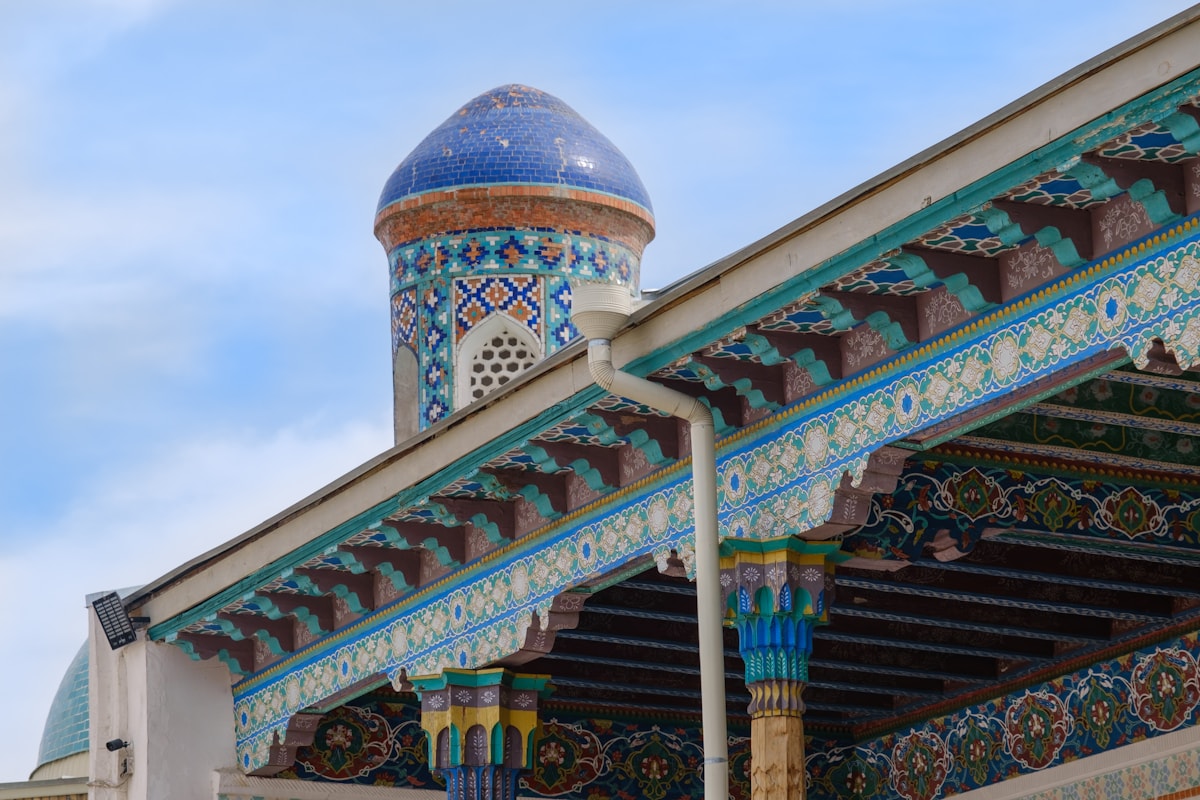
Kokand is one of the oldest cities of the Ferghana Valley and, in the 18th–19th centuries, the capital of the powerful Kokand Khanate. The main monument of that era is the Khudayar Khan palace, or Urda. This isn't a medieval ruin like Ak-Saray, but a comparatively late, almost "twilight" splendor: the palace was built shortly before the khanate fell to the Russian Empire. Its colorful facade and tragic fate make the Urda one of the most expressive places in the valley.
What is the Khudayar Khan palace?
Over the main entrance, a carved Arabic inscription with the ruler's name survives to this day — "the Great Said Muhammad Khudayar Khan." The palace stood on a rise, a broad ramp led to the ceremonial entrance, and the facade with its minarets faced the city. The Urda was conceived as a visible embodiment of the khanate's might — even at the moment when that might was already declining toward its end.
What was the Kokand Khanate?
By the mid-19th century the khanate had weakened through internal strife and struggles for the throne, in which Khudayar Khan more than once lost and regained power. Against this background the Russian Empire's expansion into Central Asia unfolded. The Urda palace was built in the khanate's final years — a kind of farewell gesture of a departing era.
How lavish was it?
The finishing work continued for several more years after construction was completed — the best masters of the era were drawn in. The faceted minaret was decorated with majolica, the entrance gates became a true masterpiece of woodcarving. With its traditional layout, the Kokand palace stood out precisely in the brightness and color of its decor — the recognizable hand of Ferghana craftsmanship.
What happened to the khanate?
In this lies the poignant irony of the palace's fate. Khudayar Khan built it as a monument to what seemed eternal might, but history allotted that might only a handful of years. The building's later fate was also far from simple: the rooms were converted for the garrison's needs, and later educational institutions and a museum were housed here.
The khan built the palace to last for ages — and reigned in it only a few years. History fit into a single facade.
What can you see today?
The museum holds collections of artworks, Eastern clothing, weapons and archaeological finds. A walk through the surviving courtyards and halls lets you feel the atmosphere of the khanate's last capital. Even in its truncated form, the Urda remains Kokand's main sight and one of the symbols of the whole Ferghana Valley.
How do you get to the palace?
It makes sense to include Kokand in a route with Margilan (a center of silk production) and Ferghana — the three cities stand close together and together give a complete picture of the valley. The Urda palace will be the historic anchor here, telling of the times when Kokand was the capital of its own state.
Frequently asked questions about the Khudayar Khan palace
What is the Urda?
"Urda" means "citadel" — the name for the Khudayar Khan palace in Kokand, the ceremonial residence of the last ruler of the Kokand Khanate, built in the early 1870s.
Who was Khudayar Khan?
The last ruler of the Kokand Khanate, who reigned with interruptions in 1845–1875. This palace was built under him, and soon afterward the khanate fell.
How large was the palace?
In its original form, about 138 meters long and 65 wide, more than 100 rooms in several courtyards, a facade with four minarets. Only part of the courtyards and about 19 rooms survive.
What happened to it?
In 1876 Russian troops took Kokand, the khanate was abolished, and a garrison was quartered in the palace. Later it held educational institutions, and today a regional museum.
What's inside now?
The surviving part of the palace houses a regional museum with collections of art, clothing, weapons and archaeology, devoted to the history of Kokand and the khanate.
How do you get to Kokand?
From Ferghana or from Tashkent via the Kamchik pass. The palace is in the center of the city; seeing it takes about an hour to an hour and a half.
Want to see Uzbekistan the way the people who live here see it?
Become a Kvazar Explorer →