Kvazar · Cities · Margilan

The Yodgorlik Factory: The Living Silk of Margilan

In Margilan, silk isn't made on a conveyor belt but by hand — almost exactly as it was a thousand years ago. At the Yodgorlik factory you can trace the whole path: from the silkworm cocoon to finished khan-atlas, whose fiery patterns are recognized the world over. This isn't a museum behind glass but a living production.

A Kvazar guide · Updated 2026 · ~7 min read

Margilan is one of the oldest cities of the Ferghana Valley and the silk capital of Uzbekistan. Its fame came as far back as the first millennium: along the Great Silk Road, fabrics were carried from here to Baghdad, Kashgar, Khorasan, Greece and Byzantium. Today the heart of this tradition is the Yodgorlik factory, where the old craft is not a museum exhibit but daily work. To come here is to see how the fabric that became the country's calling card is born.

In short: Yodgorlik (Yodgorlik) is a silk-weaving factory in Margilan, the silk capital of the Ferghana Valley. It's one of the largest handmade-fabric productions in Uzbekistan, where khan-atlas (flowing silk with a characteristic "blurred" abr pattern), adras (a silk-and-cotton blend) and other fabrics are made the traditional way. The factory was founded in 1972 and has operated as a private enterprise since 2000. Here you can see the whole process live: unwinding cocoons, spinning thread, dyeing the warp with natural dyes in the abr technique, and hand-weaving. Margilan is about 9 km from Ferghana; Yodgorlik is one of the city's main sights and a logical bridge to the theme of Uzbek ikat.

What is the Yodgorlik factory?

Yodgorlik is a working silk-weaving factory in Margilan specializing in handmade fabrics. It was founded in 1972 and was once the largest silk production in the Ferghana Valley; since 2000 it has operated as a private enterprise. Unlike large mechanized mills, here the emphasis is on preserving the traditional hand technology — the very one passed down in the region from generation to generation.

That's exactly why Yodgorlik is interesting to travelers: it's not an exhibition of finished goods but a place where you can walk through the workshops and see every stage of a fabric's birth. The factory is open to visitors, gives tours and sells its own products — from lengths of khan-atlas to finished items and souvenirs.

Why is Margilan the silk capital?

Margilan has been known for silk for more than a thousand years: as far back as the first millennium, luxurious silk goods were made here, and in the early Middle Ages the city became the "silk" capital of Central Asia. From here, along the Great Silk Road, fabrics spread to Baghdad, Kashgar, Khorasan, Egypt, Greece and Byzantium. Margilan silk was prized for its softness, rich color and complex dyeing technique.

That reputation has survived to our day: Margilan is still seen as the center of Uzbekistan's silk craft, where ancient traditions are carefully preserved. The city is inseparable from its trade — and the Yodgorlik factory has become its modern symbol, linking a thousand-year history with a living production.

How is the silk made here?

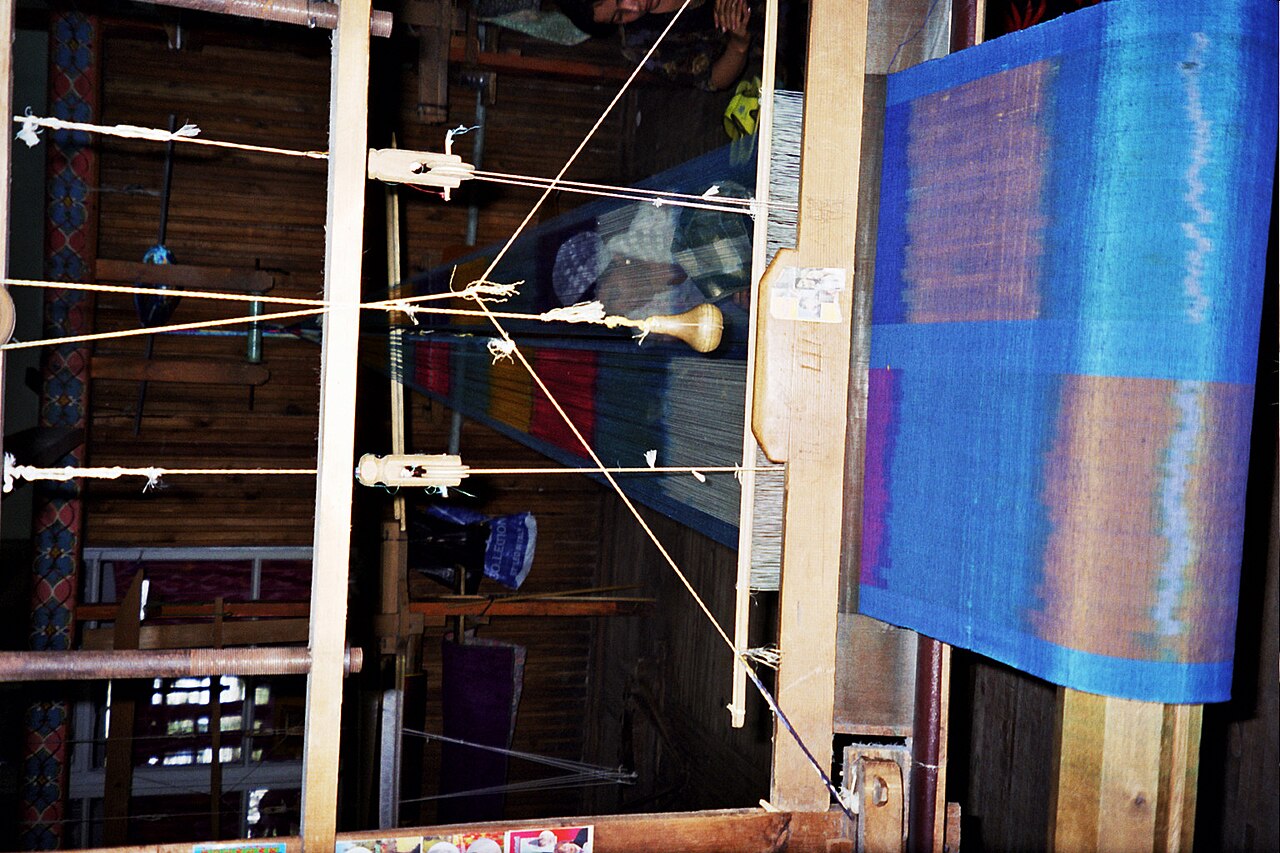
At Yodgorlik you can follow the whole cycle. First the silkworm cocoons are boiled and unwound: on a large wheel, the thin threads of the cocoons are joined into yarn (a single thread may use several dozen cocoon filaments). Then the yarn is prepared into the warp of the future fabric, dyed, and in the weaving workshop the cloth is woven by hand. Each stage is performed by the hands of the masters.

The key and most spectacular moment is dyeing in the abr technique. The warp threads are bound into bundles and dipped repeatedly in dye, leaving the needed sections uncolored. Thanks to this, after weaving, the characteristic "blurred," seemingly bleeding pattern emerges on the fabric. Natural dyes were traditionally used, and some dyeing methods the Margilan masters once adopted from Indian artisans.

"Abr" means "cloud." The khan-atlas pattern is blurred, with soft flowing edges — like a cloud or watercolor. This isn't a flaw or a style of drawing but a consequence of the technology itself: the warp threads are dyed before weaving, so the outlines of the pattern inevitably "drift." The word "abr" itself means "cloud" — an exact name for this effect.

How does khan-atlas differ from adras?

The factory makes several kinds of fabric. Khan-atlas ("khan's atlas," "royal silk") is pure flowing silk with a bright abr pattern, the most festive and recognizable. Adras is a blend of silk and cotton, denser and more practical. Besides these, they produce shoyi (classic soft silk), the dense bekasam and jujunchu for everyday clothing, and cotton boz. Each fabric has its own purpose and cultural meaning.

Many khan-atlas and adras patterns are tied to the region's tradition and symbolism — this isn't just decoration but a whole language of ornament. We tell more about the origin, symbolism and technology of these fabrics in a separate piece on ikat and khan-atlas; the Yodgorlik factory is the place where all that theory can be seen in action.

Here silk isn't shown behind glass — here it's made by hand, the way it was made a thousand years ago.

Why is it worth coming here?

A visit to Yodgorlik turns the abstract "ancient tradition" into something tangible: you see with your own eyes how a glowing fabric is born from an unremarkable cocoon. It's a rare chance to catch a living craft, not its reconstruction, and to understand why Uzbek silk was prized for centuries along the Silk Road. For many travelers it's one of the strongest impressions of the Ferghana Valley.

And from here you can take away a meaningful souvenir — a length of fabric or an item whose story of creation you understand. Unlike faceless market purchases, a thing from Yodgorlik carries the memory of a specific place and craft. This is the "deep" tourism for which it's worth turning into Margilan.

How do you get to the factory?

The Yodgorlik factory is in Margilan, about 9 km from Ferghana. The journey usually starts from Tashkent: first you reach Ferghana (by plane, train or the road over the Kamchik pass), and from there to Margilan it's about 20–30 minutes by taxi or shared van. At the factory itself, allow an hour to an hour and a half for a workshop tour and the shop.

It makes sense to combine Margilan in one route with Kokand and Ferghana: Kokand gives the history of the khanate, Margilan the living craft, Ferghana serves as a convenient base. Such a triangle through the Ferghana Valley shows the region from different sides and complements the classic Uzbekistan route well.

Frequently asked questions about the Yodgorlik factory

What is Yodgorlik?

A silk-weaving factory in Margilan where khan-atlas, adras and other fabrics are made the traditional hand way. Founded in 1972, open to visitors.

What can you see there?

The whole silk production process: unwinding cocoons, spinning thread, dyeing the warp in the abr technique and hand-weaving, plus a shop with fabrics and goods.

How does khan-atlas differ from adras?

Khan-atlas is pure silk with a bright abr pattern, a festive fabric. Adras is a blend of silk and cotton, denser and more practical.

Why does khan-atlas have a blurred pattern?

Because of the abr technology: the warp threads are dyed before weaving, bound in bundles, so the outlines of the pattern "drift." "Abr" means "cloud."

Where is Margilan?

In the Ferghana Valley in eastern Uzbekistan, about 9 km from Ferghana.

How do you get there?

Usually via Ferghana: reach it from Tashkent by plane, train or the road over the Kamchik pass, then 20–30 minutes to Margilan.

Want to see Uzbekistan the way the people who live here see it?

Become a Kvazar Explorer →