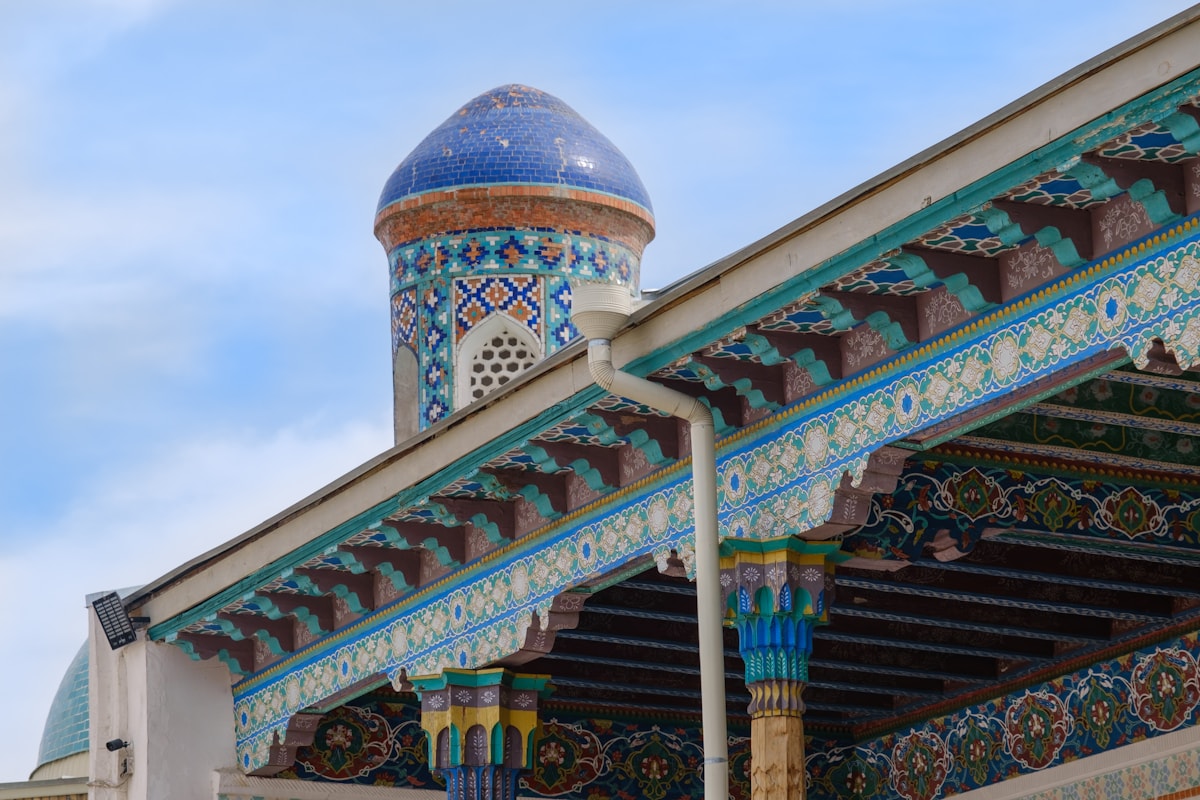
Kokand is about the history of power in the valley, not about craft like neighbouring Rishtan and Margilan. In the 18th–19th centuries it was the capital of the Kokand Khanate, and its main monument is the last khan's palace, ornate and a little sad, like all twilight luxury. In a single day Kokand comes together as a full portrait of a khanate capital and serves as a logical "gateway" to the Fergana Valley. This guide shows what to fit in, how to get there, and why Kokand comes first on the route.
What can you fit into Kokand in one day?
Kokand is not about craft, like neighbouring Rishtan and Margilan, but about the history of power in the valley. In the 18th–19th centuries it was the capital of the Kokand Khanate, one of the three Uzbek khanates alongside Bukhara and Khiva. So a day in Kokand is a reading of the valley's imperial page before moving on to its workshops.
The logic of the day is simple: the main thing is the Khudayar Khan palace, which deserves the bulk of your time. Then the Juma Mosque and, if time remains, the madrasa and necropolis. Kokand is conveniently placed first on a two-day valley route — as a "gateway" before the craft towns of Rishtan and Margilan. How to link the cities is in our Fergana Valley in two days guide.
What is the Khudayar Khan palace famous for?
Khudayar Khan was the last ruler of the Kokand Khanate: he reigned on and off and was driven into exile shortly before the valley was annexed by the Russian Empire in the 1870s. His palace is the twilight luxury of a fading state, where oriental tradition already sits beside eclecticism. A large part of the palace was living quarters for the court. Even in the surviving portion you can see how lavish the design was.
Bukhara and Khiva keep their khanates as shrines and fortresses. Kokand keeps its as a palace — ornate, tiled and a little sad, because it is the last luxury before the end.
What to see in the Juma Mosque and nearby?
The Juma Mosque shows Kokand from the spiritual side, as the palace does from the secular. A minaret in the middle of the courtyard is a rare composition, and it is sometimes possible to climb it by finding the caretaker with the key. The Norbutabiy Madrasa and the khans' necropolis complete the picture: in a single day Kokand comes together as a full portrait of a khanate capital — power, faith and memory within walking distance.
How do you reach Kokand, and when is best to go?
Kokand makes sense either as a one-day point on entering the valley or as the first day of a two-day route. If you continue to Rishtan and Margilan, it is convenient to carry on from Kokand by taxi or with a driver. Book train tickets ahead at railway.uz. What to see further in the valley is in our Margilan and Rishtan in one day and Fergana Valley in two days guides.
What to eat, and how to end the day?
The valley is the country's most fertile and "edible" region, and here food is as much a part of the experience as architecture. After the palace and the mosque, an unhurried lunch in a teahouse is the right way to feel the leisurely rhythm of Kokand life. From here the route leads on to crafts — the ceramics of Rishtan and the silk of Margilan.
Frequently asked questions about one day in Kokand
Is one day enough for Kokand?
Yes, a day is enough for the historical core: the Khudayar Khan palace, the Juma Mosque, the Norbutabiy Madrasa and the Dakhmai Shohon necropolis are compact and done without rushing. Kokand often serves as the first one-day stop on entering the Fergana Valley, before the craft towns of Rishtan and Margilan.
What must you see in Kokand?
Above all the Khudayar Khan palace — one of the most ornate palaces in Central Asia, completed in 1873, with tiled facades and surviving halls. Then the Juma Mosque with its minaret in the middle of the courtyard, the Norbutabiy Madrasa and the royal necropolis. The palace deserves the bulk of the day.
How do you get to Kokand from Tashkent?
By train over the Kamchik pass and the long tunnel — Kokand is the first stop in the valley, a few hours' journey. The alternative is a taxi over the pass (around four to five hours). The station is about two kilometres from the centre. Book train tickets ahead at railway.uz.
Who was Khudayar Khan?
Khudayar Khan was the last ruler of the Kokand Khanate, reigning on and off in the mid-19th century and driven into exile shortly before the valley was annexed by the Russian Empire in the 1870s. His palace in Kokand is the main monument of the era and a symbol of the khanate's twilight.
Should you visit Kokand on its own or as part of a valley route?
It is more convenient as part of a route: Kokand logically comes first on a two-day trip through the Fergana Valley, as the historical 'gateway' before the craft towns of Rishtan and Margilan. A separate day trip from Tashkent is possible, but most of the time goes on the road.
Want to see Uzbekistan the way the people who live here see it?
Become a Kvazar Explorer →