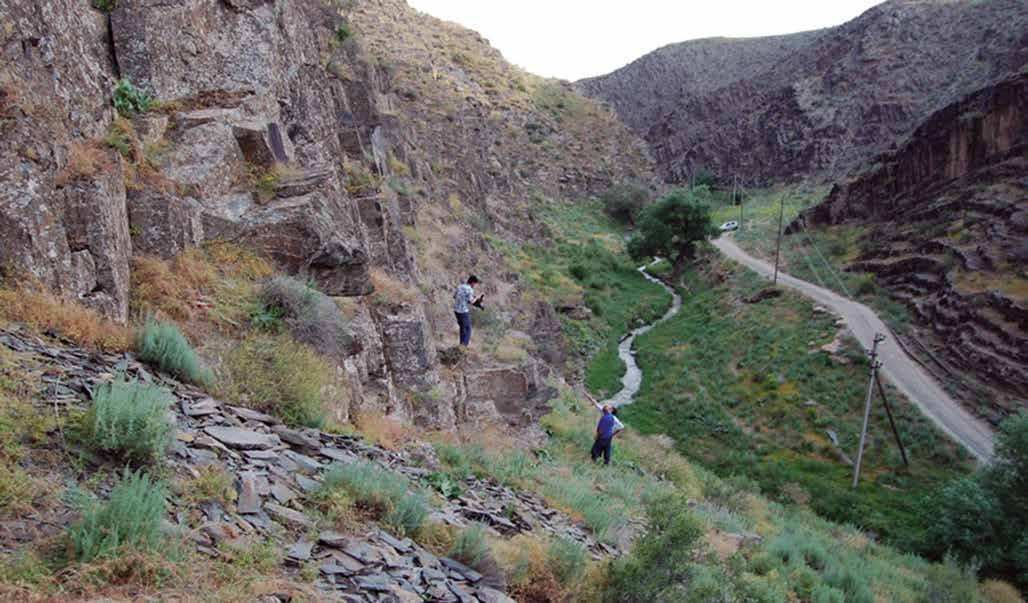
Sarmishsay is a gorge in the Nurata mountains where black basalt rocks are covered in thousands of rock carvings left over many millennia. It is the most ancient, pre-Islamic stratum of history on the lands of modern Uzbekistan — one thousands of years older than Samarkand and Bukhara. This guide covers what is depicted on the rocks, why it matters for understanding the country, and how to include Sarmishsay in a trip to Lake Aydarkul.
What is Sarmishsay?
Sarmishsay is not a museum or a monument in the usual sense but a living rock face covered in messages from the depths of time. People came here to carve over millennia, layer upon layer, long before cities and writing existed. For the traveller it is a rare chance to touch the most ancient stratum of history on the lands of modern Uzbekistan — one thousands of years older than Samarkand and Bukhara.
The gorge lies in the Nurata mountains and is usually seen on the way to Lake Aydarkul and the yurt camps, so it combines conveniently with that trip. How the whole trip works is in our Aydarkul and Nurata in two days guide.
What exactly is depicted on the petroglyphs?
The value of the petroglyphs is that they are the direct speech of people who left no written texts: from the drawings you can read what they hunted, which animals they knew, what they believed. The ibex is one of the most frequent images, and its recurrence hints at a special, possibly cultic, meaning. It is worth studying the rocks slowly and with a guide: without explanation many figures are easy to miss among the natural pattern of the stone.
Samarkand tells of the golden age of science. Sarmishsay tells of a time when writing did not yet exist, and people spoke to the future in the only way available: by carving images into the eternal black stone.
Why does it matter for understanding Uzbekistan?
If you stack the layers — the rock carvings of Sarmishsay, the Buddhist stupas of Termez, the Zoroastrian and Hellenistic finds, and then Islamic architecture — you get a picture of a continuous, multi-layered civilisation on one land. Sarmishsay is its very foundation. That is why it is worth seeing not as "stones with scratches" but as the first chapter of a very long book. Other pre-Islamic layers are covered in our Termez guide.
How do you reach and see Sarmishsay?
It is practical to build Sarmishsay into the first day of an Aydarkul trip: a stop on the way into the nature area, before Nurata and the lake. A guide is especially important here — they will show the key panels of carvings and explain the scenes, otherwise it is easy to walk past. How the whole route works is in our Aydarkul and Nurata in two days guide, and an overview of the nature areas is in our mountains of Uzbekistan guide.
Frequently asked questions about Sarmishsay
What is Sarmishsay?
Sarmishsay is a gorge in the Nurata mountains with one of Central Asia's largest open-air galleries of rock carvings. On black basalt rocks here are thousands of petroglyphs — by various estimates, from several thousand to ten thousand images: hunting scenes, animals, people and rituals, left over many millennia.
How many petroglyphs are at Sarmishsay?
Estimates vary: different sources give from several thousand to about ten thousand images, carved on the gorge's rocks over many millennia. The exact number depends on what counts as a separate carving and on ongoing research. In any case it is one of the largest galleries of rock art in the region.
How do you get to Sarmishsay?
The gorge lies in the Nurata mountains near the city of Navoi and is usually seen on the way to Lake Aydarkul and the yurt camps. The easiest way is with a driver and guide; without a guide many carvings are hard to find. Sarmishsay is logically included in the first day of an Aydarkul trip.
Do you need a guide to see the petroglyphs?
Highly advisable: without explanation many figures are easy to miss among the natural pattern of the stone, while a guide will show the key panels and explain the scenes — what was hunted, which animals were known, what was believed. With a guide the visit turns from 'stones with scratches' into a reading of ancient history.
Why does Sarmishsay matter for understanding Uzbekistan?
It shows the most ancient, pre-Islamic and pre-literate stratum of the region's history — one thousands of years older than Samarkand and Bukhara. The petroglyphs are a reminder that civilisation on the lands of modern Uzbekistan did not begin with domes but goes back tens of thousands of years and is made up of many layers, from rock carvings to Islamic architecture.
Want to see Uzbekistan the way the people who live here see it?
Become a Kvazar Explorer →